

5 Ways to Measure the Real ROI of Salesforce
- ROI Isn’t Automatic: Simply deploying Salesforce doesn’t guarantee returns. Many organizations turn it into an expensive system of record instead of a system of growth.
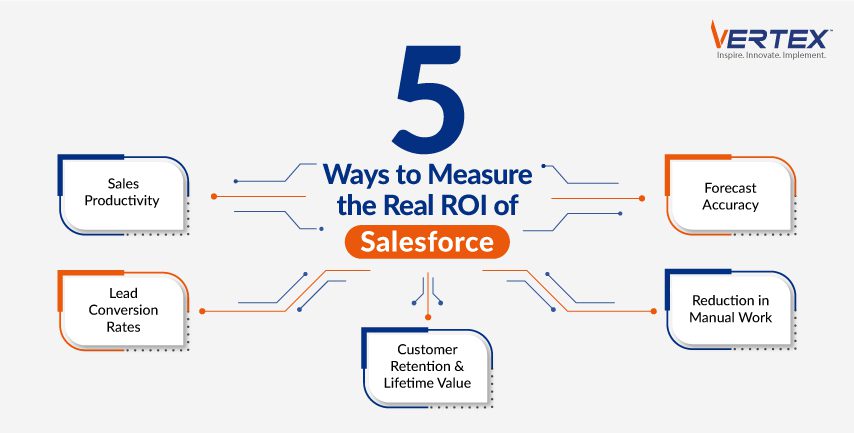
- Measure Five Ways: Track sales productivity, lead conversion rates, customer retention and lifetime value, automation savings, and forecast accuracy to quantify real impact.
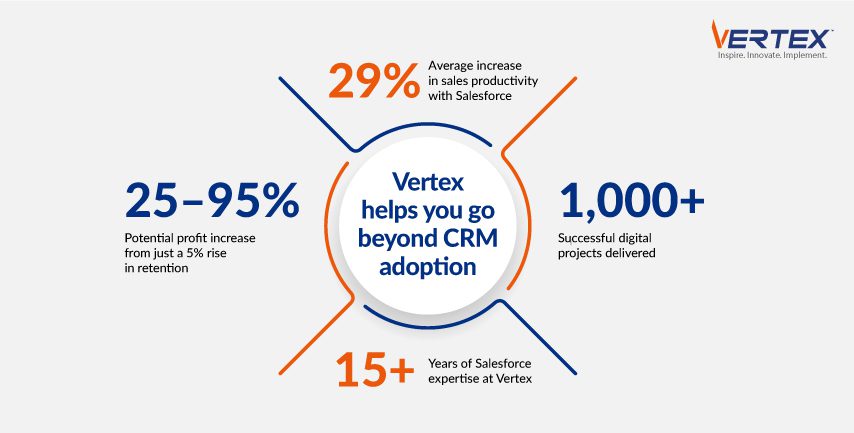
- The Numbers Back It: Salesforce users report a 29% average lift in sales productivity, and a 5% retention gain can raise profits by 25% to 95%.
- Automation Cuts Waste: Automated workflows reduce manual data entry and admin tasks, so you can measure ROI through saved hours and faster response times.
- Strategy Drives Returns: Strong ROI depends on clear goals, integration, and high user adoption. Vertex brings 15+ years of Salesforce expertise and 1,000+ projects to help you go beyond basic CRM adoption.
Many organizations invest in Salesforce, expecting improved sales performance, better customer visibility, and stronger revenue growth.
But here’s the thing, they miss most of the time.
Simply implementing Salesforce does not guarantee ROI.
In many organizations, Salesforce becomes an expensive system of record instead of a system of growth.
Dashboards are created, data is captured, and workflows are configured, but leadership still struggles to clearly quantify business impact.
So how do you measure whether Salesforce is truly delivering value?
Here are five practical ways to measure the real ROI of Salesforce.
Increase in Sales Productivity
One of the primary objectives of Salesforce is to help sales teams work smarter and close deals faster.
With centralized customer information, automated activity tracking, and AI-powered opportunity insights, sales representatives spend less time on administrative tasks and more time engaging with customers.
According to Salesforce’s own customer success metrics, companies using Salesforce report an average 29% increase in sales productivity.
Instead of sales teams manually updating spreadsheets or searching through email threads, they can access complete customer interaction history in one place.
This improves preparation for customer conversations and shortens sales cycles.
Tracking metrics such as time spent selling vs administrative work, average deal cycle duration, and activities per sales rep can help quantify productivity improvements.
Improvement in Lead Conversion Rates
Salesforce enables organizations to track leads from the first touchpoint to the final conversion.
Features such as lead scoring, automated nurturing workflows, and segmentation help sales teams prioritize high-quality opportunities.
Research shows that companies using CRM systems effectively can significantly improve conversion performance.
Monitoring metrics such as lead-to-opportunity conversion rate and opportunity-to-win ratio provides a clear view of Salesforce’s revenue impact.
Better Customer Retention and Lifetime Value
Customer acquisition is expensive.
Improving retention often delivers significantly higher ROI.
Salesforce enables organizations to build a 360-degree view of each customer, including interaction history, purchase patterns, service cases, and engagement activity.
This unified view allows teams to identify at-risk customers early and proactively address issues.
According to research by Bain & Company, increasing customer retention by just 5% can increase profits by 25% to 95%, depending on industry.
Salesforce helps customer success teams identify upsell opportunities, track renewal timelines, and improve customer engagement.
Key metrics to track include:
- Customer retention rate
- Customer lifetime value
- Renewal rates
- Upsell and cross-sell revenue
Reduction in Manual Work through Automation
Salesforce automation capabilities reduce the need for manual data entry and repetitive administrative tasks.
Automated workflows can handle:
- Lead assignment
- Follow-up reminders
- Approval processes
- Data synchronization across systems
- Case escalations
Organizations can measure ROI by evaluating reductions in manual work hours, faster response times, and improved operational efficiency.
Improved Forecast Accuracy
Sales forecasting plays a critical role in planning inventory, hiring, marketing investments, and revenue targets.
Salesforce provides real-time visibility into pipeline health, deal stages, and probability scoring, enabling more accurate forecasting.
Accurate forecasts help organizations optimize inventory levels, allocate budgets more effectively, and make strategic decisions with greater confidence.
Measuring ROI requires the Right Strategy
Salesforce is a powerful platform, but its true ROI depends on how effectively it is implemented, integrated, and adopted across teams.
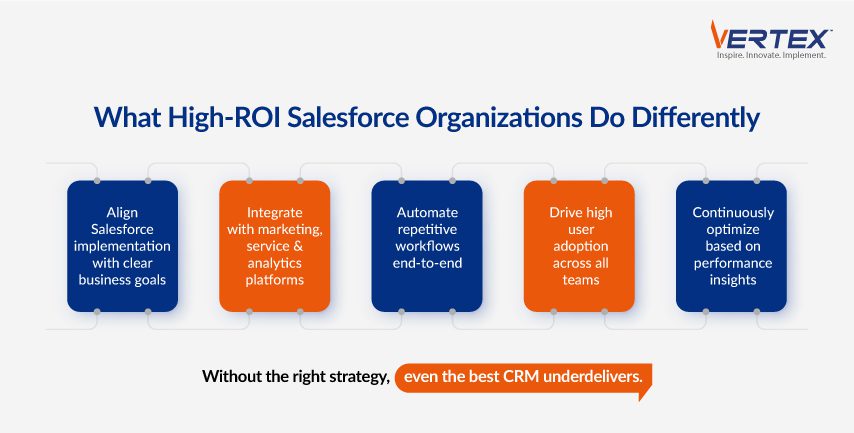
Organizations that achieve strong ROI typically:
- Align Salesforce implementation with clear business goals
- Integrate Salesforce with marketing, service, and analytics platforms
- Automate repetitive workflows
- Ensure high user adoption across teams
- Continuously optimize processes based on performance insights
Without the right strategy, even the best CRM platform can underdeliver.
How Vertex Helps Organizations Maximize Salesforce ROI
At Vertex, we help organizations unlock the full value of Salesforce through a structured, outcome-driven approach.
Using our proprietary Vertex Intellectual Property (IP) utilities and over 15 years of Salesforce expertise, we:
- Plan and execute precise Salesforce solution roadmaps that guide budgeting, sequencing, and long-term scalability
- Accelerate implementation timelines, helping organizations go live faster while reducing cost and minimizing project risks
- Deliver a comprehensive suite of Salesforce services, including consulting, customization, integration, optimization, and ongoing support
Our long track record of successful Salesforce implementations enables organizations to move beyond basic CRM adoption and build connected customer ecosystems that drive measurable business growth.
Connect with our team today to learn how you can maximize the ROI of your Salesforce investment and turn customer data into business growth.
Recent Blogs

9 July, 2026

9 July, 2026

8 June, 2026

8 June, 2026

1 May, 2026

30 April, 2026

10 April, 2026

3 April, 2026
Recent News

26 February, 2026

6 December, 2025

1 August, 2025

2 February, 2025

14 November, 2024

4 November, 2024

1 August, 2024

6 March, 2024