

Post-Implementation Strategies: Measuring ROI on Salesforce Investments After Go-Live
Return on Investment (ROI) is the only number or metric that is most sought in any industry.
ROI for Salesforce implementation is also crucial, as the returns can only tell whether the applied CRM is effective or not post-go-live.
In this article, we will learn about strategies to measure ROI to highlight the key performance indicators (KPI) and cost considerations.
Continuous evaluation of the system is necessary in order to make sure the CRM is profitable and yields the results promised before it goes live.
Strong returns usually trace back to the build itself, which is why getting the Salesforce development services right before go-live sets the ceiling on the ROI you can measure afterward.
Understanding ROI in Salesforce
Return on investment is a financial metric that tells us the profitability of an investment.
This is done by comparing the net profit to the cost put in. The ROI formula can be understood as mentioned below.
{ ROI = (Net Profit / Cost of investment) X 100 }
This formula can be used to determine whether the Salesforce investment is yielding positive returns or not.
This allows the organization to compare multiple of its investments.
However, returns do not always mean money; for example, there was an increase in communication time from employees to customers and leads, a 28% increase in sales results, as evident in the report done by TTMS.
An increase in these metrics is also a form of ROI.
Importance of Measuring ROI
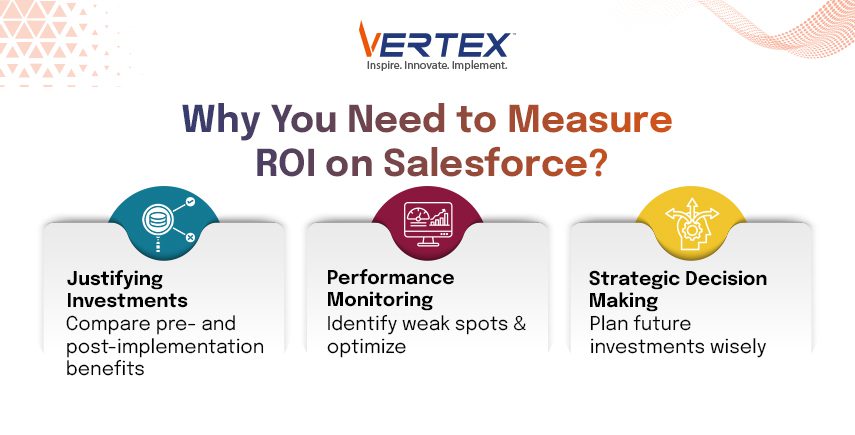
Measuring ROI in Salesforce is essential for several reasons:
- Justifying Investments: Any investment has to be justified by quantifiable results, or else the business runs down. In this case, after the implementation of Salesforce, the returns should reflect the benefits from the time when Salesforce was not live.
- Performance Monitoring: With routine performance evaluation, businesses can identify the areas where they need to improve and work on the betterment of that part. This benefits the organization in the long run.
- Strategic Decision-Making: Once you understand the ROI structure and the factors involved, you can reevaluate your plan, and with the newfound knowledge, you can work on future investments. Nucleus Research also stated that investing in CRM is a sound decision, as you get $8.71 for every dollar you spend on CRM.
Key Performance Indicators (KPIs)
KPIs are defined to evaluate ROI; this helps in effectively tracking the ROI of a business.
Some of the common KPIs are mentioned below.
- Sales Efficiency: Salesforce is most beneficial and crucial for the sales department. So, metrics like lead conversion ratio and sales cycle are defined to help assess the efficiency of the sales team.
- Customer Satisfaction: Customer feedback score or happiness index and Net Promoter Scores (NPS) indicate improvements in customer relationships due to better service delivery. If the numbers are down, the business needs to work on customer service.
- Operational Efficiency: The smooth and quick operation of any organization is also counted as an ROI. Salesforce can automate processes and improvements.
Establishing KPIs
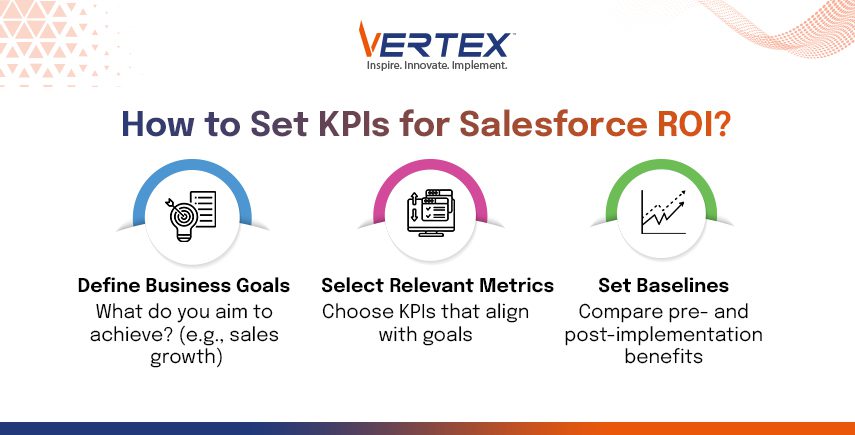
We talked about some of the common and known KPIs; now, you will be learning how you can set your own KPIs. This
- Define Business Goals: The first step is to define what the organization strives to achieve with Salesforce; for example, it can be better sales or customer retention.
- Select Relevant Metrics: Choose KPIs that directly reflect progress towards these goals, ensuring they are feasible.
- Set Baselines: We need a control baseline that needs to be established before you make Salesforce go live. This will be useful for comparison before and after the CRM is online.
Cost Considerations
If we were to calculate the ROI without any room for error, then we need to make sure that we start with an accurate cost calculation.
The cost associated with Salesforce can be categorized into two parts.
- Initial Costs: Licensing fees, customization expenses, and training costs incurred during the setup phase.
- Ongoing Costs: Subscription fees, maintenance expenses, and costs related to continuous training and support.
According to Closeloop, the estimated price for Salesforce implementation ranges between $10,000 and $150,000, depending on the project’s complexity.
Post-implementation, the organization can expect a rise in total revenue by 37%.
Calculating Total Costs
To calculate total costs effectively:
- Document All Expenses: Maintain a detailed record of all costs associated with the Salesforce implementation.
- Include Hidden Costs: Indirect costs are to be measured as well, such as the time an employee spends on his training and potential disruptions.
- Regularly Review Costs: Periodic assessments of costs will help you to identify the areas where savings can be made.
Measuring Benefits
The benefits derived from Salesforce can be divided into measurable and non-measurable categories:
Measurable Benefits
These benefits can be quantified and directly linked to financial outcomes:
- Increased Revenue: We have to track sales growth in order to attribute it to improved sales processes facilitated by Salesforce.
- Cost Savings: Once the CRM is live, we have to measure the reductions in cost as there will be automation processes and improvements because of Salesforce.
- Enhanced Productivity: Calculate time saved by employees through streamlined workflows and reduced administrative tasks.
Non-Measurable Benefits
These are harder to quantify, but are equally important:
- Improved Customer Relationships: Improved engagement through personalized interactions will result in increased customer loyalty.
- Better Data Management: Centralized data can improve decision-making processes across the organization.
Continuous Evaluation Post-Go-Live
Post-implementation, it is crucial to monitor the changes Salesforce is bringing to the organization.
For checking whether or not the desired outcomes have been met.
Regular Monitoring
Establish a routine to monitor KPIs; this will ensure that the business metrics are tracked for their performance against the previously established goals.
- Monthly or quarterly reviews of key metrics.
- Utilizing dashboards for real-time data visualization.
Feedback
Creating channels for feedback from users can provide insights into areas needing improvement.
This could include:
- Surveys or interviews with sales teams about their experiences using Salesforce.
- Regular check-ins with stakeholders to discuss challenges and successes.
Adjustments Based on Insights
Organizations need to register feedback and then make changes based on this feedback.
- Additional training sessions for employees.
- Customizing features based on user needs or industry trends.
If businesses want continuous growth, then they have to be flexible.
Investments do not yield a short-term profit; we have to aim for the long run, and keeping the business open to change and Dynamic will help us achieve that.
Case Studies Highlighting Successful ROI Measurement
Examining successful implementations provides valuable insights into best practices for measuring ROI.
For example:
- A study by Nucleus Research found that companies using Salesforce experienced an average increase in sales productivity by 15% within just a few months post-implementation.
- A random customer survey of 6,200 customers of Salesforce CRM by an independent third party, Market Tools Inc., revealed that the increase in the total volume of sales leads was 50% and the increase in the number of leads converted to sales opportunities was also 50%.
Conclusion
Measuring ROI on Salesforce investments is much more than just the cost of implementation and the revenue post-implementation.
This is a multilevel process that involves quantified and user experience data to give out the actual ROI.
We define KPIs and then track those KPIs: customer happiness index, employee retention, and even the efficiency of employees post-implementation.
We track lead conversion ratio and sales cycle as well.
Now, if you need any help with Salesforce implementation and want to learn more about practices and strategies to track your ROI, you can reach out to us at Vertex CS.
Recent Blogs

3 August, 2026

27 July, 2026
20 July, 2026

13 July, 2026

6 July, 2026

29 June, 2026

22 June, 2026

15 June, 2026
Recent News

26 February, 2026

6 December, 2025

1 August, 2025

2 February, 2025

14 November, 2024

4 November, 2024
1 August, 2024

6 March, 2024