


Accelerating Digital Transformation with Modern Integration Strategies: APIs, Microservices, and Beyond
- Why integration matters: Point-to-point integrations are rigid and slow, so modern digital transformation depends on APIs, microservices, and event-driven design.
- APIs: APIs act as standard contracts between systems, and the API management market is projected to grow from $4.5 billion in 2022 to
- 3.7 billion by 2027.
- Microservices: Breaking monoliths into small, independent services speeds deployment, improves scalability, and isolates faults.
- Advanced strategies: Event-driven architecture enables real-time responsiveness, while low-code/no-code platforms let business users build integrations.
- Best practices: Build a full API strategy, treat microservices as products, invest in iPaaS, adopt zero trust early, and foster cross-team collaboration.
We all talked about how the future will have everything from flying cars to AI-enabled homes, smart devices, and businesses.
Well, the flying cars are still in beta phase, but everything else is here.
The most prevailing of which is the digital transformation of businesses and organizations.
It is no longer a distant thought but a reality, and the entire world is hopping on this, so what are you doing to stay on top of everyone else?
With everyone having access to the best of services, the difference comes from how you implement that service and get the desired results.
This is where the modern integration strategies come into play; these are backed by APIs and microservices.
They also use a lot of AI-enabled architectural patterns; this is the new face of digital transformation.
The Integration Imperative: Why Traditional Approaches Fall Short
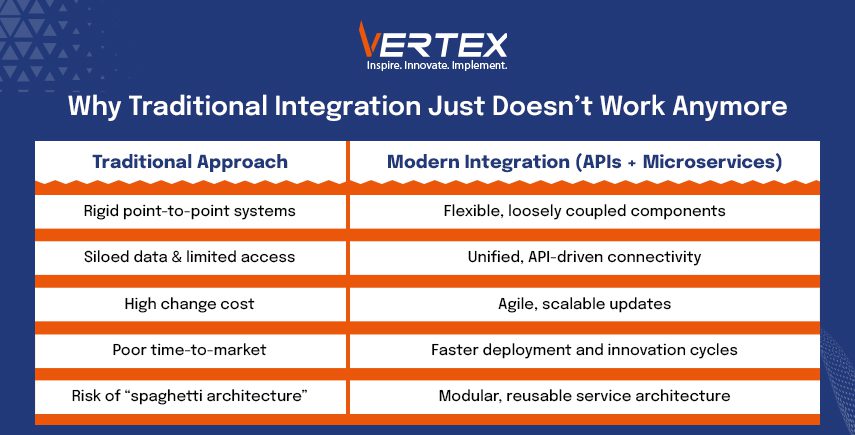
The traditional integration methods are functional, no doubt, but they rely on outdated methods and technologies.
They use point-to-point connections, which are rigid, slow, and prone to “spaghetti architecture.”
When any business integrates an array of cloud services or SaaS applications, this rigidity will hamper the integration and result in issues.
We have discussed some of these issues below for better understanding:
- Siloed Data: Most of the time, information gets trapped in different systems, preventing a complete view of customers, operations, and performance.
- Slow Innovation: If we make changes in a coupled system arrangement, then the probability of ripple effects skyrockets. Making rapid deployment nearly impossible.
- High Costs: If we have to make complex, custom changes and integrations, they will cost more and deplete resources.
- Lack of Agility: Businesses are slow to respond to new trends and rigid in their methods. Customer demands change with time, and if the business is not flexible with them, then it can face a lot of queries from customers.
According to a report done by Veritas, the digital transformation market is set to experience substantial growth, with a projected CAGR of 22% between 2021 and 2025, reaching a market value of USD 3.7 trillion.
This report is a wake-up call on the urgency of the situation and the need for impactful integration strategies, so that businesses can capture the market with the full potential of digitalization.
APIs: The Foundation of Modern Connectivity
APIs, or Application Programming Interfaces, are the reason why modern software can interact with each other without diving into the internal complexities.
APIs are standard contracts between these software, which make sure that there is no peeking behind the curtain and no unethical data leaks.
APIs are more than technical enablers; they are responsible for creating an ecosystem of digital software.
This generates a lot of revenue.
According to a coverage by PR News, the API management market is projected to expand from $4.5 billion in 2022 to $13.7 billion by 2027, growing at a compound annual growth rate (CAGR) of 25.1%.
How APIs Accelerate Digital Transformation:
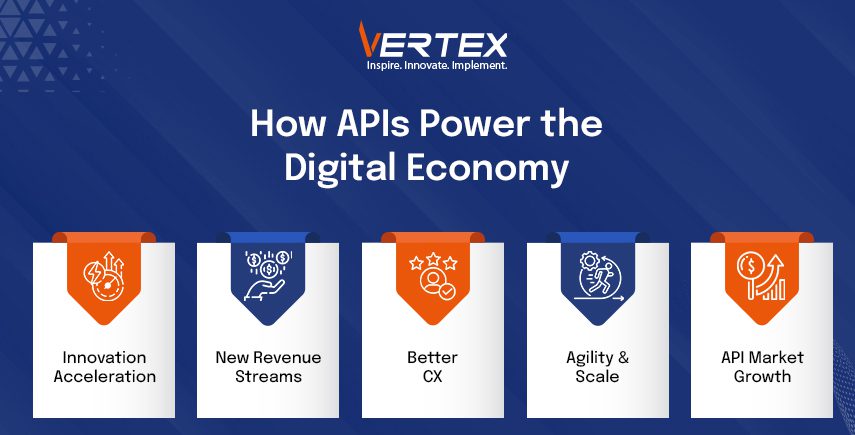
APIs are the catalyst that is accelerating Digital transformation, and we have discussed some ways in which APIs are pushing for the growth of Digital Transformation.
- Innovation Acceleration: APIs can help by exposing functionalities, which in turn can help teams, partners, and developers build applications. This promotes a culture of collaboration and creation. Companies like Google and Amazon offer APIs, such as Google Maps APIs, so that developers can build a large ecosystem of apps.
- New Revenue Streams: With the help of API services, companies have been able to develop an entirely new source of income. They allow businesses to monetize their own data and services by offering APIs. For example, OpenAI also offers API access and earns a “API Economy,” which allows businesses to monetize their data and services by offering API access.
- Enhanced Customer Experience: APIs have helped develop some of the best personalized customer experiences. The best example is banking apps, which use Banking APIs to connect banks with payment portals and merchants, enabling top-notch financial data and payment exchanges.
- Agility and Scalability: APIs provide a lot of agility and independence; they promote loose coupling, which entails that changes to one service will not affect any other services. This also makes the development and deployment of services and apps much faster.
Microservices: Deconstructing the Monolith for Greater Agility
Microservices are the reason why businesses are able to create and deploy their services much faster using APIs.
Microservices break down the monolithic application into small, independent, and loosely coupled services.
Each of these coupled services generally takes care of one business capability and communicates with other services using APIs.
This also allows for more innovation in a limited time.
Benefits of Microservices for Digital Transformation:
- Independent Development and Deployment: One of the perks of microservices is that teams are capable of developing, testing, and deploying their own microservices. This reduces dependencies and expedites the entire process.
- Scalability and Resilience: This particular trait of microservices is my favorite. If there are any issues with a single microservice, then it will not harm other microservices in any way and will not affect the workflow as well.
- Technology Heterogeneity: Microservices allow the flexibility to use different programming languages, databases, and technologies for each service, rather than being confined to a single tech stack.
- Improved Fault Isolation: As discussed earlier, the loosely coupled nature of microservices safeguards them from errors or failures.
- Easier Maintenance: Smaller codebases are much easier to understand and maintain. Furthermore, they are also easier to debug and decode, and help in reducing technical debt. Some of the famous companies that use microservices are Netflix and Amazon. They leverage microservices to deliver innovation and the best customer experience.
Beyond APIs and Microservices: Advanced Integration Strategies
Adding advanced integration strategies helps by boosting the entire framework and adds another layer of technological edge to the entire system.
If legacy applications are holding you back, start with the 6 Rs of application modernization.
Event-Driven Architecture (EDA): Real-time Responsiveness
Real-time insights are crucial, and they are the one factor that creates differences in terms of profit.
Reacting to trends and market shifts, real-time is what gives any business its edge.
Event-Driven Architecture, or EDA, is an integration pattern in which systems communicate by publishing, capturing, processing, and reacting to events.
Advantages of EDA in Digital Transformation:
- EDA makes real-time processing of data possible, along with real-time analytics, faster decision-making, and even lets you automate responses for critical scenarios.
- EDA also promotes loose coupling; in fact, it kicks it up a notch and allows services to scale independently and respond to demand spikes, if any.
- There are audit logs of events in case of errors, and there is also a secondary recovery mechanism.
- EDA can be integrated with legacy systems, microservices, and external cloud services, and it does that irrespective of their underlying technologies.
Low-Code/No-Code Integration Platforms: Democratizing Connectivity
Since demand for digital solutions is through the roof, there aren’t many skilled technical experts.
Use Low-code/no-code (LCNC) integration platforms; they provide a drag-and-drop interface that enables non-technical workers and business users to build integrations and applications with minimal or no coding.
Paired with DevOps platform engineering, these tools let IT keep guardrails in place while business teams build.
This is also proven true by the increased demand for the LCNC in the market.
According to a report done by Proficient Market Insights, the global Low-code and No-code Platform Market is poised for significant growth, projected to reach USD 256.45 billion by 2033, with a CAGR of 25.9% from 2025 to 2033.
Impact of LCNC on Digital Transformation:
- LCNC platforms cut down on the time and effort usually required to build integrations and applications.
- They enable normal businessmen and non-technical workers to build integrations and applications with ease.
- LCNC makes the work of the IT department easier with its drag-and-drop interface, so even business users can handle simple integration tasks.
- Businesses can quickly adapt to the changing requirements by making prototypes and deploying those integrations.
The Road Ahead: Best Practices for Successful Integration
Digital transformation is a multi-step process, and when we mix microservices and APIs along with technical integrations, the entire process becomes more complex.
Integration choices also depend on where workloads run, so choosing a cloud model early keeps the architecture simple.
We have discussed some of the best strategies businesses can use to benefit.
- Develop a Comprehensive API Strategy: Go with an API strategy that encompasses public, private, and partner APIs, along with proper documentation.
- Embrace a Product-Centric Approach to Microservices: Microservices should be used and treated like a product of their own and should have their own team, ownership, and boundaries.
- Invest in Robust Integration Platforms: You can use Integration Platform as a Service (iPaaS) solutions or other enterprise integration platforms that offer capabilities for API management.
- Prioritize Security from the Outset: Ensure you implement a zero-trust architecture, as more integration points introduce more potential vulnerabilities. Additionally, continuously monitor to safeguard data and integration touchpoints.
- Foster a Culture of Collaboration: Take down the boundaries of teams, operations, and businesses. Both DevOps and GitOps are crucial for a streamlined development and deployment cycle.
Conclusion
Digital transformation with modern integration techniques is a great way to streamline your business, offer new services to customers, and generate new revenue streams.
In this article, we learned that not only can digital tools help a business grow, but without a dedicated framework consisting of Microservices and APIs, the end goal is tough to reach.
Furthermore, the use of advanced tools like EDA and AI/ML will enable your business to access cutting-edge technology, move beyond digitalization, and transform into a dynamic digital landscape.
So if you wish to incorporate all this digital arsenal into your business and do not know where to start, then connect with experts at VertexCS, and we will help you transform
Recent Blogs
3 August, 2026
27 July, 2026

20 July, 2026

13 July, 2026
6 July, 2026

29 June, 2026

22 June, 2026

15 June, 2026
Recent News

26 February, 2026

6 December, 2025

1 August, 2025

2 February, 2025

14 November, 2024

4 November, 2024

1 August, 2024

6 March, 2024