

Exploring Automation Use Cases in HR, Supply Chain, Customer Service, and More
Automation of processes and tasks is no longer a concept; we see AI agents taking over mundane tasks.
There are AI-governed robots taking over production lines and eliminating any or all human error.
Now, intelligent technologies like Robotic Process Automation (RPA) and machine learning are transforming major industries.
This not only frees up human capital but also frees up significant resources.
The freed-up resources can then be used to focus on high-value and creative work.
In this article, we will explore real-world use cases of automation in Supply Chain, Human Resources, and Customer Service, and then dive into statistical data that highlights the benefits and ROI.
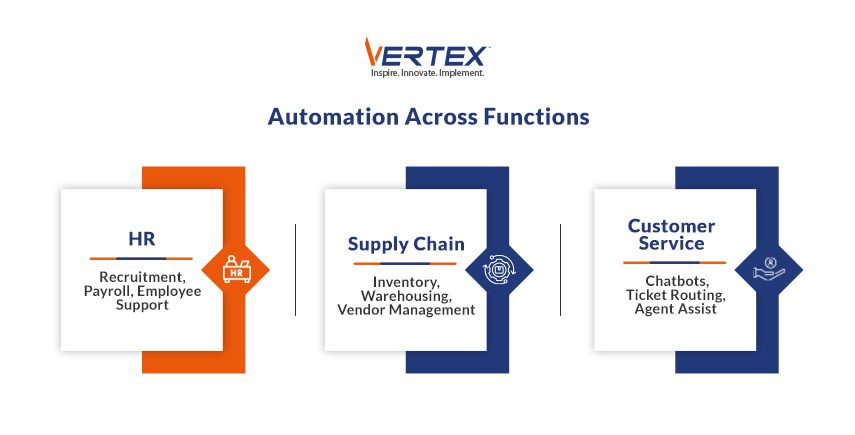
Human Resources: From Administrative Burden to Strategic Partner
Human Resources is heavily burdened by administrative tasks, including screening resumes and managing pay stubs for hundreds of employees.
Automation can help change all this and transform the work of HR professionals from administrative support to strategic business.
This can help HR develop talent and enhance employee experience.
Key Automation Use Cases & Their Impact
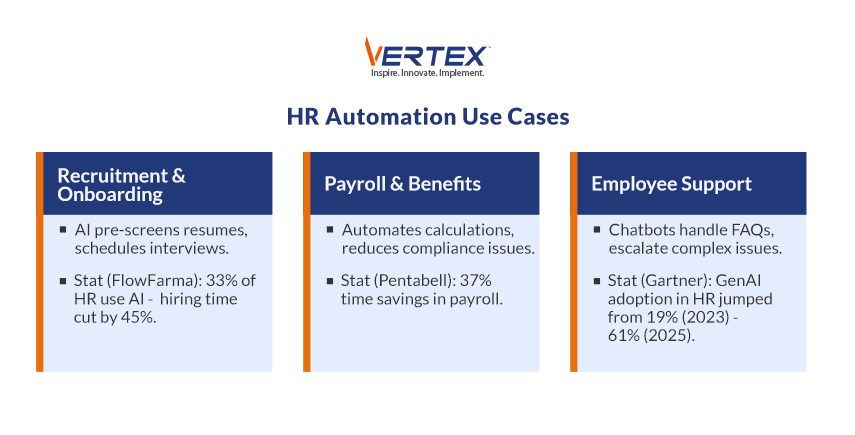
- Recruitment and Onboarding: While recruiting, HR’s have to go through hundreds of resumes just to find the right candidate. This takes up important man-hours that could have been used elsewhere at any other time. Though when we use AI to pre-screen the candidates’ resumes, we can filter out all the suitable candidates based on the criteria and the details mentioned in their resumes. Furthermore, it can also handle the task of scheduling a candidate’s interview. According to research by FlowFarma, 33% of HR professionals leverage AI not only to screen resumes but also to automate candidate searches and communication. Companies using automated screening reduce hiring time by up to 45%.
- Payroll and Benefits Management: The manual processing of payroll is prone to human error, and there will always be complications. These complications result in compliance issues and employee dissatisfaction. Automation streamlines the entire process and ensures there are no calculation errors. A study by Pentabell showed that dedicated automation platforms can achieve a 37% time savings in payroll administration.
- Employee Support and HR Service Delivery: AI-powered chatbots and virtual assistants are the best when it comes to handling high volumes of employee queries with ease. These chatbots can take care of basic FAQs and can even escalate the issue and have a human agent intervene. With chatbots in action, HR teams can now focus their expertise and solve underlying complex issues. According to a Gartner report, the share of HR leaders who are actively planning or already deploying GenAI has jumped from 19% in June 2023 to 61% by January 2025.
These stats only confirm that HR automation is not about reducing the workforce but actually managing the entire department more efficiently and with fewer errors.
Supply Chain: Enhancing Visibility and Operational Resilience
The supply chain includes a bunch of very complex processes, such as inventory management and logistics.
Both of these processes can do much better with automation and AI-backed services.
AI can help give a better approach and agility for operations, and also reduce the cost of operations.
Key Automation Use Cases & Their Impact
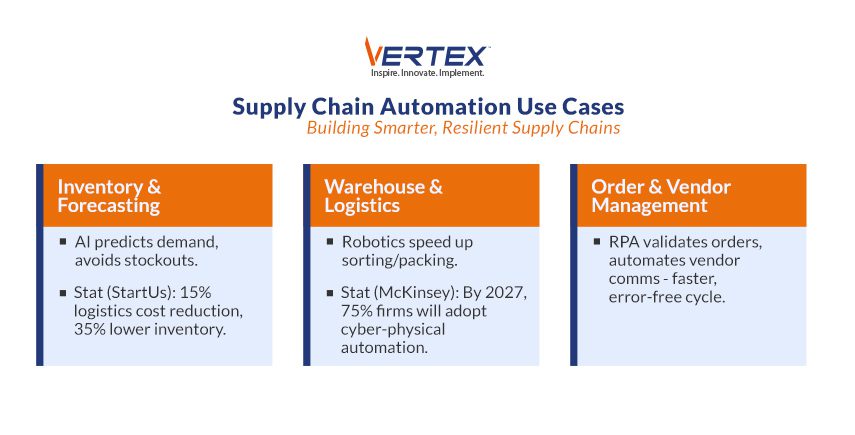
- Inventory Management and Demand Forecasting: Organizations still rely on manual spreadsheets to manage inventory. This often leads to overstocking or stockouts. AI-driven systems can help analyze historical sales data and then prepare a sheet that shows the projections, data trends, and external factors to generate highly accurate demand forecasts. According to a report by StartUs Insights, AI solutions address these by automating repetitive tasks and optimizing processes. Early adopters reported up to a 15% reduction in logistics costs and a 35% decrease in inventory levels through AI adoption.
- Warehouse and Logistics Automation: In warehouses, a lot of robotics and autonomous packing have taken over. They significantly increase the speed and accuracy of packing and sorting. According to a McKinsey report, by 2027, over 75% of companies are expected to adopt some form of cyber-physical automation in their warehouse operations. This report indicates a significant gain in the global logistics company’s integrated AMRs into the pick process, and saw an increase in productivity and a 20% decrease in space.
- Automated Order and Vendor Management: Automation streamlines the entire process of order-to-cash from the point of entry to invoice generation. RPA’s are more than capable of validating purchase orders, managing vendors, and communicating without human intervention. Using RPA not only fastens the financial cycle but also helps in reducing all the human error that generally takes place.
All these automations create a new and better supply chain that is more than capable of handling increased demand and risks, even at a global scale.
Customer Service: Elevating Experience and Boosting Agent Productivity
The customer is king, and, by extension, customer service is a frontline function. This is where speed.
Personalization and efficiency matter the most. This is also the field where automation is most progressive.
You can now handle all the inquiries and grievances using AI and chatbots.
This not only increases the efficiency but also works great in giving the customer a personalized customer experience.
Key Automation Use Cases & Their Impact:
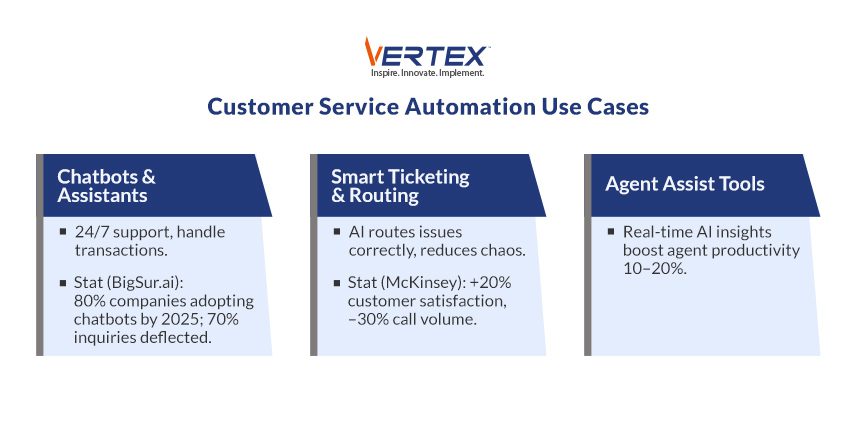
- Chatbots and Virtual Assistants: With AI chatbots you can have 24-7 customer service and they are also better at handling basic transactions. According to a study done by BigSur.ai, virtual customer assistant automation is rapidly scaling. 80% of companies will adopt AI chatbots by 2025, 95% of AI users report major cost and time savings, and 70% of inquiries can be deflected with virtual assistants. Leaders are using these tools to boost productivity, improve resolution speed, and enhance customer satisfaction.
- Automated Ticketing and Smart Routing: Automation also helps by correctly navigating the escalated query to the right responder, with all the context.AI is great at cataloguing the queries based on their nature. This helps in reducing traffic and chaos among the human attendants. A McKinsey study found that companies that adopted AI saw up to a 20% increase in customer satisfaction and a 30% reduction in call volume.
- Agent Assist and Productivity Tools: AI with real-time insights can be really helpful for human agents. They are able to increase the productivity levels by at least 10-20%. When we automate low-value interactions, companies can make use of their skilled human agents for more complex queries. By doing this, the result will be a better customer service satisfaction rate and, overall, a better customer happiness index rate.
Conclusion
This article sheds light on the fact that automation is not a threat to the human occupants but actually a great tool.
By leveraging AI, companies can generate new revenue streams and nurture existing ones.
We also covered how AI can improve the HR ecosystem and increase their productivity and strategic approach.
Furthermore, we also learned how, with AI, the financials of the organisations can be better handled without any human error.
This cross-functional integration of automation is creating a more agile, efficient, and resilient enterprise.
If you are looking to get some answers on how you can get on the AI wagon, then connect with our expert team at VertexCS.
Recent Blogs
3 August, 2026

27 July, 2026

20 July, 2026
13 July, 2026
6 July, 2026

29 June, 2026

22 June, 2026

15 June, 2026
Recent News

26 February, 2026

6 December, 2025

1 August, 2025

2 February, 2025

14 November, 2024

4 November, 2024

1 August, 2024

6 March, 2024