

Real-Time Data Pipelines Empower Data-Driven Decisions With Data Engineering
- Real-time pipelines process data as events, not batches: They ingest and act on data the moment it arrives from IoT devices, web, and mobile apps, which lets businesses make data-driven decisions at the speed of the market instead of hours later.
- Microservices and event-driven design keep the pipeline resilient: Each service runs independently, so one failure does not take the whole system down, and the architecture scales up or down as data volumes fluctuate.
- Complex event processing and stateful streaming turn raw streams into decisions: CEP engines spot patterns and fire automated alerts as events occur, while stateful processing tracks sequences and aggregations over time for context that batch jobs miss.
- Data quality and governance run inline, not after the fact: Real-time validation, anomaly detection, and automated remediation keep streaming data accurate, so the decisions built on it can be trusted.
- High-frequency trading and remote patient monitoring show the payoff: Financial platforms execute trades on live market data and healthcare systems analyze wearable data for immediate intervention. Vertex designs and runs real-time pipelines on Kafka and Kinesis across the full lifecycle. Connect with Vertex.
Data pipelines that operate in real time are an essential component of contemporary data engineering.
They play a crucial role in the process of using the speed, volume, and diversity of data that is produced by the digital ecosystems of today.
Their strategic implementation empowers businesses to make data-driven decisions at the speed of market changes, delivering competitive advantage and operational efficiency.
A fast pipeline only pays off when the output is easy to read, which is where data visualization services turn that live data into decisions teams can act on.
Architectural Foundation
At the core of a real-time data pipeline is its architecture, which necessitates a robust, scalable, and fault-tolerant design.
Unlike traditional batch processing systems, real-time pipelines process data as it arrives, necessitating architectures capable of handling high throughput with low latency.
Technologies such as Apache Kafka or Amazon Kinesis form the backbone of these systems, enabling efficient data ingestion and streaming.
- Microservices Architecture: Leveraging a microservices architecture facilitates the scalability and resilience of real-time data pipelines. Each component or service operates independently, ensuring that the failure of one service doesn’t bring down the entire system. This architectural choice supports the dynamic scaling of services in response to data volume fluctuations, a critical requirement for handling real-time data.
- Event-driven Design: At its core, a real-time pipeline is event-driven, processing data items as events. This design pattern enhances responsiveness and agility, allowing systems to react to data in real-time. Implementing an event-driven architecture requires a nuanced understanding of event sourcing, CQRS (Command Query Responsibility Segregation), and the management of event streams, ensuring that data is accurately processed, stored, and made available for downstream applications.
Advanced Processing Techniques
- Complex Event Processing (CEP): Real-time analytics requires the ability to detect patterns and relationships within data streams instantly. CEP engines analyze and process data events as they occur, enabling immediate insight generation and decision-making. Advanced CEP involves sophisticated pattern recognition, temporal event correlations, and real-time analytics to drive automated actions and alerts.
- Stateful Stream Processing: Unlike stateless processing, which treats each data item in isolation, stateful processing keeps track of data across events. This approach is crucial for applications that require an understanding of event sequences or aggregations over time. Implementing stateful processing involves intricate management of state persistence, fault tolerance, and consistency, ensuring that the system can recover from failures without data loss.
Data Integration and Management
Integrating diverse data sources in real-time presents unique challenges.
Real-time data pipelines must accommodate various data formats and velocities, ensuring seamless data ingestion from IoT devices, web applications, mobile apps, and more.
This integration requires sophisticated ETL (Extract, Transform, Load) processes, schema management, and data normalization techniques to prepare data for analysis and decision-making processes.
- Data Quality and Governance: Ensuring the accuracy, completeness, and reliability of real-time data is important. Implementing robust data quality frameworks and governance protocols within the pipeline safeguards against data corruption and ensures compliance with regulatory standards. Advanced data pipelines incorporate real-time data validation, anomaly detection, and automated remediation processes to maintain data integrity.
Case Studies and Applications
In industries ranging from finance to healthcare, real-time data pipelines drive innovation and operational excellence.
For instance, in financial services, they enable high-frequency trading platforms to execute transactions based on real-time market data.
In healthcare, they support remote patient monitoring systems, analyzing data from wearable devices to provide immediate medical interventions.
Aligning with Vertex’s Data & Analytics Services
Vertex Consulting Services stands at the forefront of implementing and managing advanced real-time data pipelines.
Our expertise spans the full spectrum of data engineering, from architectural design to the deployment of sophisticated real-time analytics solutions.
We empower businesses to unlock the full potential of their data, ensuring they can respond to market dynamics with agility and precision.
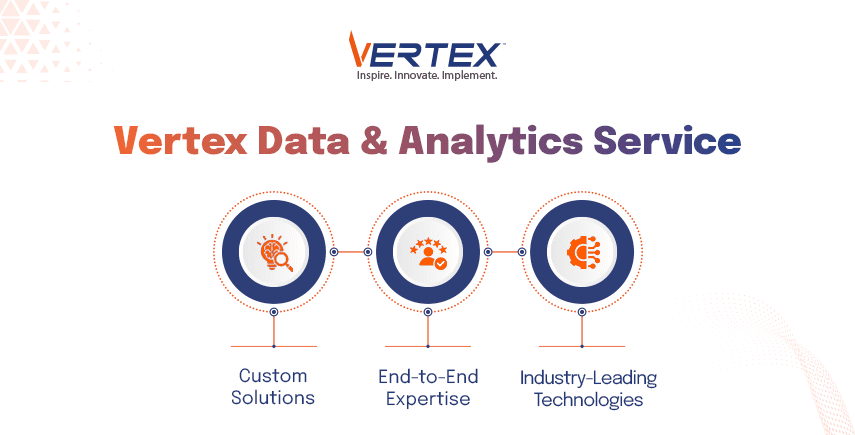
- Custom Solutions: Recognizing the unique challenges and objectives of each business, Vertex offers tailored real-time data pipeline solutions. Our approach ensures that your data architecture aligns with your strategic goals, leveraging cutting-edge technologies to deliver performance, scalability, and reliability.
- End-to-End Expertise: With a team of seasoned data engineers, architects, and analysts, Vertex provides comprehensive services that encompass the entire lifecycle of real-time data pipelines. From initial consultation and design to implementation, optimization, and ongoing support, we ensure your data infrastructure operates at its peak.
- Industry-Leading Technologies: Vertex harnesses the latest in data processing and analytics technologies, staying ahead of industry trends to provide our clients with innovative solutions. Our expertise includes advanced data streaming platforms, microservices architectures, and cloud-native services, ensuring your business is equipped for the data-driven era.
Transform your business with real-time insights and data-driven decision-making.
Discover how Vertex can elevate your data capabilities, ensuring you stay ahead in an evolving digital landscape.
Contact us today to explore how we can tailor a real-time data pipeline solution to your business needs, driving growth and innovation.
This detailed exploration into real-time data pipelines underscores the importance of advanced, meticulously designed systems.
By focusing on sophisticated architectural designs, processing techniques, and the integration of diverse data sources, businesses can leverage real-time data to its fullest potential.
Recent Blogs

22 June, 2026
15 June, 2026

8 June, 2026
18 May, 2026

1 May, 2026

30 April, 2026
10 April, 2026
3 April, 2026
Recent News

26 February, 2026

6 December, 2025

1 August, 2025

2 February, 2025

14 November, 2024

4 November, 2024
1 August, 2024

6 March, 2024