


The Future of Business Automation: MuleSoft RPA and its Successful Implementation
- Automation is a necessity: It saves time, reduces costs and improves efficiency across a range of business processes.
- MuleSoft connects the enterprise: The platform links applications, systems and devices, enabling the data sharing and collaboration that RPA depends on.
- Three core benefits: Faster data integration with fewer errors, flexible scaling as automation needs change, and better collaboration across departments.
- Five steps to success: Define automation goals, assess existing systems, choose the right tools, build a strong team, and continuously monitor and optimize.
In today’s fast-paced business world, automation is no longer a luxury, but a necessity.
Automation can save time, reduce costs, and improve efficiency in a range of business processes.
With the rise of technology platform MuleSoft, businesses have the opportunity to take their automation efforts to the next level.
Before you automate, it helps to know when transformation is only an upgrade and not a real change in how work gets done.
MuleSoft is a platform that enables businesses to connect various applications, systems, and devices across the enterprise.
This allows for greater data sharing and collaboration, which can be particularly valuable for businesses looking to implement RPA.
With MuleSoft, businesses can streamline their RPA implementation and achieve greater automation success.
Benefits of MuleSoft RPA
There are several benefits to implementing MuleSoft RPA.
First, it can help reduce the time and effort required for data integration.
MuleSoft’s powerful data integration capabilities can help businesses connect disparate systems and automate data flows, which can save time and improve data accuracy.
By automating these processes, businesses can also reduce the risk of human error and free up employees to focus on more strategic tasks.
Another advantage of MuleSoft RPA is improved scalability.
As businesses grow and evolve, their automation needs will also change.
MuleSoft’s flexible architecture allows for easy scaling, ensuring that businesses can adapt their automation efforts to meet their changing needs.
This can be particularly important for businesses in industries with rapidly changing regulatory requirements or other external factors.
MuleSoft RPA can also help improve collaboration across departments and teams.
By breaking down silos and enabling greater data sharing, businesses can achieve greater collaboration and communication between departments.
This can lead to improved decision-making and more efficient processes overall.
Steps to Implement MuleSoft RPA
Successfully implementing MuleSoft RPA requires careful planning and execution.
Here are some key steps to follow:
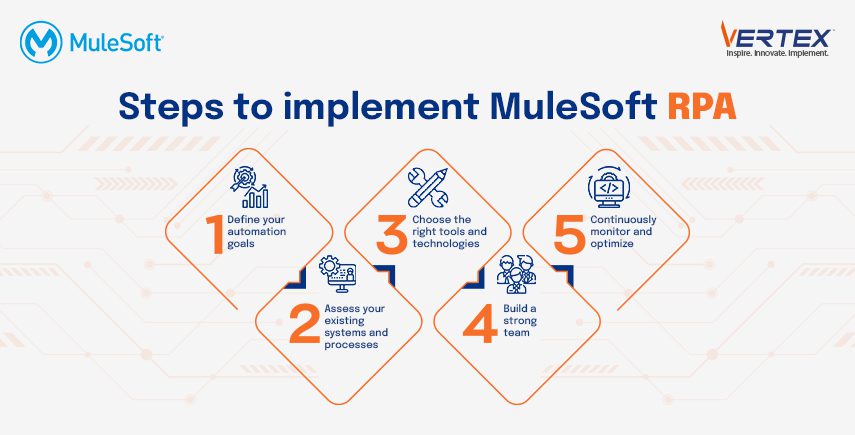
1. Define your automation goals
Before implementing MuleSoft RPA, businesses should define their automation goals and identify the specific processes they want to automate.
This will help ensure that the automation effort is aligned with the business’s overall strategy and objectives.
2. Assess your existing systems and processes
In order to successfully integrate MuleSoft with RPA, businesses should have a thorough understanding of their existing systems and processes.
This will help identify any potential roadblocks or challenges that may arise during the implementation process.
3. Choose the right tools and technologies
Once the automation goals and existing systems have been assessed, businesses can choose the right tools and technologies to enable MuleSoft RPA.
This may involve selecting an RPA tool that is compatible with MuleSoft, or investing in additional data integration tools to support the automation effort.
4. Build a strong team
Successful automation requires a strong team with the right skills and expertise.
Businesses should assemble a team with experience in RPA, MuleSoft, and data integration, and provide the necessary training and support to ensure success.
5. Continuously monitor and optimize
Once MuleSoft RPA has been implemented, businesses should continuously monitor and optimize the automation effort.
This may involve identifying areas for improvement, addressing any issues that arise, and adjusting as necessary.
Conclusion
In conclusion, the future of business automation lies in the integration of technologies such as MuleSoft and RPA.
By combining these powerful tools, businesses can achieve greater automation success and reap the benefits of increased efficiency, scalability, and collaboration.
To successfully implement MuleSoft RPA, Vertex Computer Solutions has a team of experts who follow best practices such as defining automation goals, assessing existing systems, choosing the right tools, building a strong team, and continuously monitoring and optimizing the automation effort.
Recent Blogs

3 August, 2026

27 July, 2026

20 July, 2026

13 July, 2026

6 July, 2026

29 June, 2026

22 June, 2026

15 June, 2026
Recent News

26 February, 2026

6 December, 2025

1 August, 2025

2 February, 2025

14 November, 2024

4 November, 2024

1 August, 2024

6 March, 2024