

5 Reasons why Manufacturing Costs are still Rising even while sitting on a Data Goldmine
- Data alone does not cut costs: manufacturers sit on a data goldmine, yet costs keep rising because insight-driven execution, not raw data, reduces spend. The Manufacturing Leadership Council reports 70% of manufacturers still enter data into spreadsheets manually.
- Fragmented systems hide cost drivers: when production data lives in MES, financials in ERP, and supply chain data in separate procurement tools, leaders cannot see a complete cost picture or trace a root cause.
- Legacy infrastructure stalls optimization: legacy systems remain in 74% of manufacturing and engineering organizations, so even real-time data cannot drive savings when core systems cannot adjust output or planning.
- Insight must reach the workflow: dashboards do not change behavior on their own. Embedding analytics into automated maintenance alerts, dynamic inventory optimization, and AI-driven scheduling turns data into measurable cost savings.
- Break silos to protect margins: aligning procurement, operations, finance, and logistics around one real-time data foundation controls enterprise-wide cost. Vertex integrates and modernizes manufacturing data end to end. Connect with Vertex.
For manufacturers, cost savings are a never-ending focus, even in the best of times. But today, the global manufacturing sector is facing a new reckoning.
Geopolitical disruption, energy volatility, and labor shortages are pushing margins to their limit, while the pressure to digitize and decarbonize continues to intensify.
Turning that pressure into an advantage is where digital manufacturing solutions come in, connecting shop-floor data to the decisions that actually move cost out of operations.
In such a unique environment, cost management isn’t just about survival, but about building the foundation for a competitive edge in the years ahead.
The companies that will thrive are those prioritizing cost management, supply chain resilience, automation, and AI to turn today’s challenges into a long-term advantage.
But if manufacturers are sitting on a data goldmine, why aren’t costs going down?
Because data alone doesn’t reduce costs.
Insight-driven execution does.
Here are 5 reasons why manufacturing costs remain stubbornly high even in highly digitized environments.
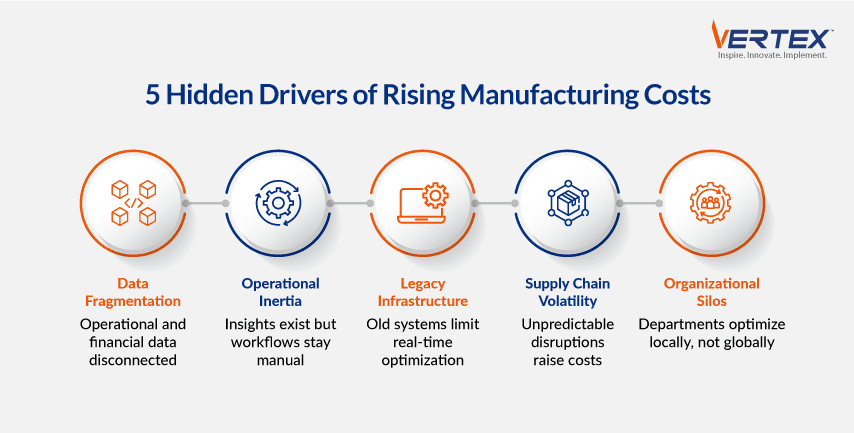
Fragmented Data
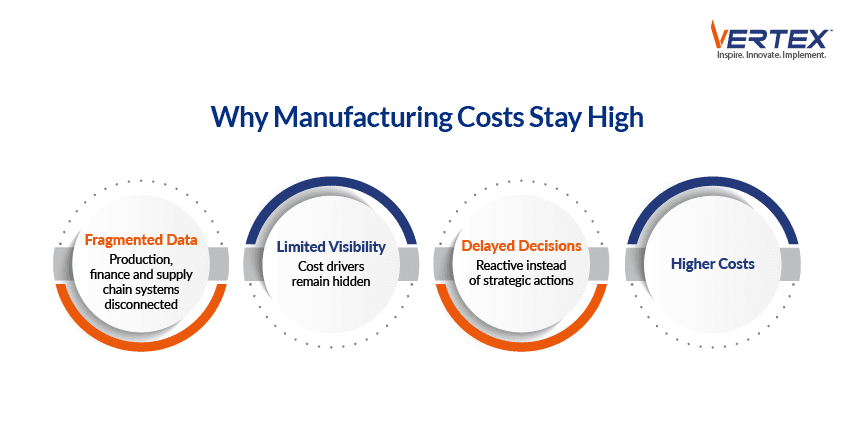
Most manufacturing organizations operate across multiple plants, geographies, and systems.
Production data may live in MES platforms.
Financial data sits in ERP systems.
Supply chain information resides in separate procurement tools.
Without integration, leaders cannot see a complete cost picture.
For instance, a plant manager may know that machine downtime has increased by 8%, but without correlating that with procurement delays or supplier quality issues, the root cause remains unclear.
As a result, reactive decisions replace strategic interventions.
According to the Manufacturing Leadership Council, 70% of manufacturers still enter data into spreadsheets manually.
At Vertex, we have helped manufacturers unify operational, financial, and supply chain data into centralized analytics environments.
When systems speak to each other, cost drivers become visible and actionable.
Insights aren’t Embedded into Daily Operations
Many manufacturers have invested in dashboards and reporting tools.
Executives can view production KPIs and cost trends in real time.
But the real problem lies in the behavior.
Dashboards don’t automatically change behavior.
We unpack this exact gap in automotive analytics that miss targets, where plants had rich data but still fell short.
If predictive maintenance analytics identify a machine likely to fail in 10 days, but maintenance scheduling remains manual, downtime still happens.
If analytics highlight supplier performance issues, but procurement processes aren’t optimized, material costs continue to fluctuate.
Data must move from ‘reporting’ to ‘operational decision-making.’
Embedding analytics into workflows such as automated maintenance alerts, dynamic inventory optimization, or AI-driven production scheduling turns insight into measurable cost savings.
Legacy Systems Slow Down Cost Optimization
Manufacturing is capital-intensive, and many facilities still rely on decades-old infrastructure.
While new IoT layers may capture data, legacy core systems often lack the flexibility to process advanced analytics at scale.
According to research, legacy systems are still prevalent in 74% of manufacturing and engineering organizations.
For instance, real-time energy monitoring might reveal inefficiencies in peak consumption periods.
But if energy contracts and production planning systems cannot dynamically adjust output based on that data, savings opportunities are lost.
Modernizing core systems without disrupting production is critical.
Vertex specializes in enabling gradual, low-risk modernization strategies that integrate advanced analytics while preserving operational stability.
Supply Chain Volatility Masks Hidden Cost Drivers
Global supply chains have become increasingly unpredictable.
Material shortages, geopolitical risks, freight cost spikes, and regulatory changes create constant cost pressure.
Manufacturers may collect supplier performance data, transportation data, and demand forecasts, but without advanced predictive models, they remain reactive.
Consider a scenario where a key supplier’s lead time increases by two weeks.
If that insight doesn’t immediately trigger production planning adjustments, manufacturers may resort to expensive expedited shipping or last-minute sourcing at premium rates.
With robust data analytics and scenario modeling, manufacturers can simulate disruptions, evaluate alternative sourcing strategies, and proactively mitigate cost spikes.
Organizational Silos Prevent End-to-End Visibility
Manufacturing cost efficiency isn’t just about production.
It’s about alignment between procurement, operations, finance, logistics, and sales.
Often, each function optimizes its own KPIs but not overall profitability.
For example:
- Procurement negotiates bulk discounts, increasing inventory holding costs
- Sales pushes aggressive promotions without factoring in production capacity constraints
- Operations focus on output volume rather than cost per unit
When departments operate in silos, data insights fail to translate into enterprise-wide cost control.
Vertex works closely with manufacturing leaders to implement unified data platforms and cross-functional analytics frameworks that align KPIs across departments.
When everyone works from the same real-time data foundation, decisions support overall margin optimization.
Turn your Data to Cost Advantage
The manufacturing industry does not lack information.
It lacks orchestration, integration, and execution.
To truly control rising costs, manufacturers must:
- Break down data silos across plants and systems
- Modernize legacy infrastructure strategically
- Embed analytics into operational workflows
- Use predictive modeling to manage supply chain volatility
- Align cross-functional KPIs around total cost efficiency
When done right, the results are powerful: reduced downtime, optimized inventory, lower energy consumption, improved supplier performance, and stronger margins.
Manufacturers who transform data into intelligent, automated decision-making don’t just reduce costs, they build resilience.
At Vertex Computer Systems, we bring decades of experience helping manufacturing organizations unlock the full value of their data ecosystems.
From data integration and analytics implementation to enterprise modernization and supply chain optimization, our solutions are designed to deliver measurable, sustainable cost impact.
If your manufacturing costs continue to rise despite growing volumes of operational data, it may be time to rethink how that data is being used.
Connect with Vertex today to turn your data goldmine into a competitive cost advantage.
Recent Blogs

3 August, 2026

27 July, 2026

20 July, 2026

13 July, 2026

6 July, 2026

29 June, 2026

22 June, 2026

15 June, 2026
Recent News

26 February, 2026

6 December, 2025

1 August, 2025

2 February, 2025

14 November, 2024

4 November, 2024

1 August, 2024

6 March, 2024