
The Data Strategy Mistake 80% of Companies are Making
- Technology-First Thinking Kills ROI: Building a data strategy around tools — data lakes, dashboards, AI — without defining business outcomes first leads to expensive infrastructure with very little impact.
- Outcomes Before Technology: Successful organizations ask what they want to achieve — reduce costs, predict churn, improve forecasting — before selecting any data platform or analytics tool.
- Poor Data Quality Costs Millions: Gartner estimates misaligned data quality costs organizations $12.9M per year, and IBM found 43% of COOs cite it as their top organizational challenge.
- Strategy Is More Than Storage: A real data strategy requires governance frameworks, integrated systems, and analytics embedded in operational workflows — not just a centralized data warehouse.
- Three Habits of Data Leaders: Define business outcomes first, prioritize data quality and governance, and embed predictive analytics directly into everyday decision-making workflows.
Over the past decade, companies have invested billions in becoming ‘data-driven’.
Data lakes have been built, dashboards deployed, and analytics platforms implemented across departments.
On paper, everything looks impressive.
But the truth is difficult to digest for most.
Despite massive investments, many organizations still struggle to turn data into meaningful business outcomes.
In fact, a large number of data initiatives never move beyond experimentation.
According to research from the Cambridge Centre for Business Analytics, up to 80% of AI and analytics projects fail to deliver the intended business value, often due to poor strategic alignment and a lack of operational integration.
So what mistakes are organizations making?
Let’s find out.
The Technology-First Trap
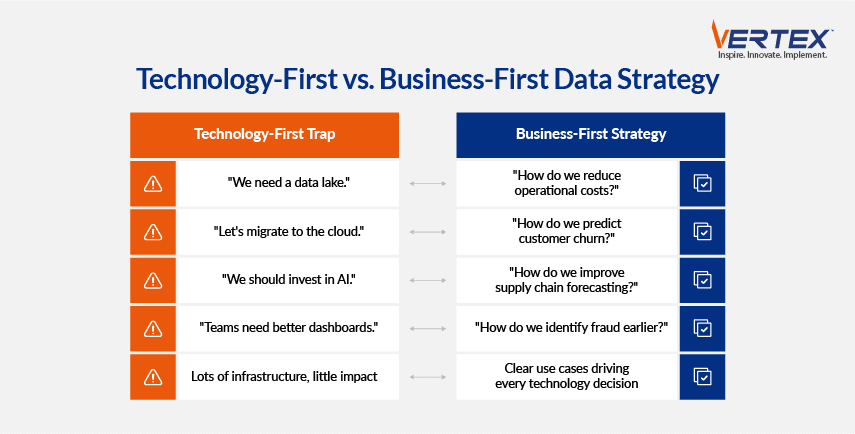
When organizations begin building their data strategy, the conversation often starts with tools:
- “We need a data lake.”
- “Let’s migrate everything to the cloud.”
- “We should invest in AI.”
- “Our teams need better dashboards.”
These decisions aren’t wrong, but when technology leads the strategy, the outcome often becomes fragmented.
Data platforms get implemented without clear use cases.
Analytics tools generate dashboards that few people rely on.
AI pilots remain stuck in experimentation.
All of this results in having lots of data infrastructure, but very little impact.
What a Business-First Data Strategy Looks Like
Successful organizations approach data strategy differently.
Instead of starting with technology, they start with questions like:
- How can we reduce operational costs?
- How can we predict customer churn?
- How can we improve supply chain forecasting?
- How can we identify fraud earlier?
Only after defining these goals do they determine what data, tools, and systems are required.
This shift from technology-first to outcome-first thinking is what separates successful data-driven organizations from those still struggling to extract value.
The Cost of Poor Data Strategy
The impact of misaligned data strategy goes far beyond underused dashboards.
Poor data quality, fragmented systems, and inconsistent governance can have significant financial consequences.
According to Gartner, poor data quality costs organizations an average of $12.9 million per year due to operational inefficiencies, lost productivity, and poor decision-making.
Additionally, an IBM Institute for Business Value study found that 43% of chief operations officers cite data quality issues as one of their biggest organizational challenges, with many estimating multi-million-dollar losses annually due to unreliable data.
These numbers highlight a very important truth that data problems are rarely technical.
They are always more strategic.
Data Strategy Is More Than Data Storage
Another common misconception is that data strategy is simply about centralizing information.
While data warehouses and lakes are important, they are only part of the equation.
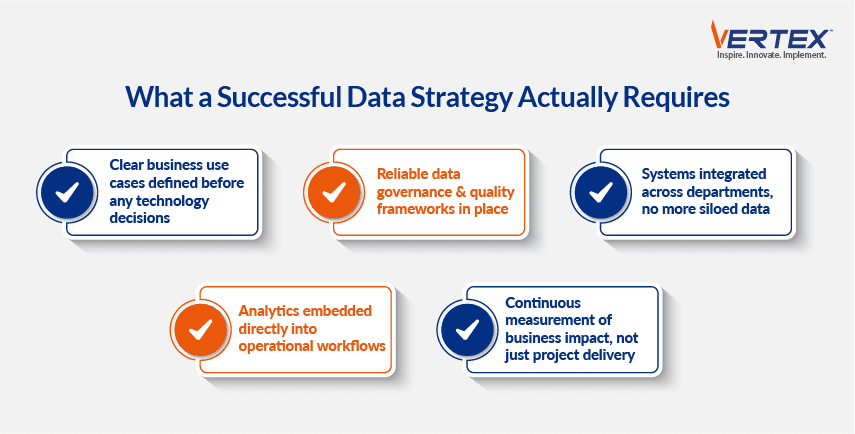
A successful data strategy requires:
- Clear business use cases
- Reliable data governance and quality frameworks
- Integrated systems across departments
- Analytics embedded directly into operational workflows
- Continuous measurement of business impact
Without these elements, data initiatives often remain disconnected from daily decision-making.
Turning Data into Business Advantage
The organizations that successfully leverage data do three things well:
- They define clear business outcomes before investing in technology
- They prioritize data quality, governance, and integration across systems
- They embed analytics and predictive insights directly into workflows
When these elements come together, data stops being a passive resource and becomes a powerful competitive advantage.
How Vertex Helps Organizations Avoid This Mistake
At Vertex Computer Systems, we help organizations move beyond fragmented data initiatives and build strategies that deliver measurable results.
With deep expertise in data engineering, analytics, enterprise integration, and modernization, Vertex works closely with business and IT leaders to align data initiatives with real operational goals.
Our approach focuses on building scalable data ecosystems, strengthening governance frameworks, and embedding analytics directly into business processes, ensuring that data investments translate into faster decisions, improved efficiency, and sustainable growth.
The biggest mistake companies make with data strategy isn’t choosing the wrong technology.
It is starting with technology in the first place.
A successful data strategy begins with business outcomes, builds the right data foundation, and integrates analytics into everyday decision-making.
If your organization has invested heavily in data but is still struggling to see meaningful impact, it may be time to rethink the strategy.
Connect with Vertex Computer Systems today to explore how a modern, outcome-driven data strategy can help unlock the true value of your data.
Recent Blogs

3 August, 2026

27 July, 2026

20 July, 2026

13 July, 2026

6 July, 2026

29 June, 2026

22 June, 2026

15 June, 2026
Recent News

26 February, 2026

6 December, 2025

1 August, 2025

2 February, 2025

14 November, 2024

4 November, 2024

1 August, 2024

6 March, 2024