

Why the Best Analytics Projects Focus Beyond Dashboard Delivery
- 80% of Analytics Projects Fail: Most don’t deliver business value because they’re built around available data and technology, not the decisions the business actually needs to make.
- Build Around Decisions, Not Data: Dashboards should answer business-critical questions like churn risk or production failures. Metrics with no link to action are just passive reports.
- Data Quality Builds Trust: Poor data quality costs organizations $12.9M a year, so governance, validation rules, and shared metric definitions are what make analytics trustworthy.
- Embed Insights into Workflows: Insights only create value when they trigger action. Connect dashboards to tools like Teams, Salesforce, and Power Automate, with automated alerts and clear follow-up.
- Adoption Decides Success: A polished dashboard is worthless without user adoption. Role-based training, KPI ownership, and Vertex’s 100+ implementations turn analytics into faster decisions.
In a world of increasing opportunities to capture data, it is essential to understand why analytics projects fail, especially when organizations have invested so heavily in resources.
A Gartner report says that 80 percent of data science projects will fail.
Most initiatives don’t deliver business benefits because they solve the wrong problem.
The problem with these pilots is that most of them are too technology-focused, quite like science fair projects.
They are not driven by the challenges organizations face, and hence end up not being useful for the business.
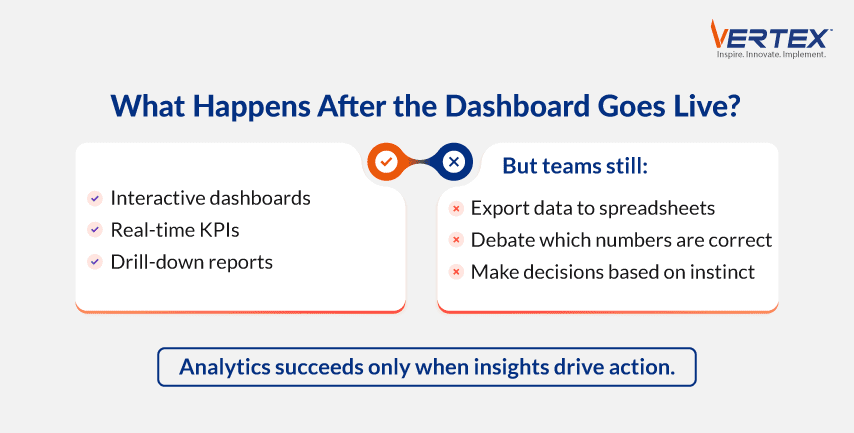
The modern dashboards have interactive charts, drill-down capabilities, real-time KPIs, and polished visualizations.
Leadership applauds the launch, teams are trained, and the project is declared a success.
But even after all this, why are decisions still based on gut instinct?
Because even after a successful dashboard launch, nothing really changes.
Teams continue exporting data into spreadsheets.
Meetings revolve around debating which numbers are correct instead of deciding what to do next.
If this sounds familiar, your organization is not alone.
According to a survey by NewVantage Partners, while nearly all large organizations are investing in data and AI, only 27% report having established a data-driven organization.
Here are four common reasons analytics projects fail after the dashboard goes live.
The Dashboard Answers Interesting Questions, Not Business-Critical Ones
One of the most common mistakes is building dashboards around available data rather than around business decisions.
Teams often create reports that display dozens of metrics, but few of them are tied to specific actions or strategic objectives.
For example, a manufacturing dashboard may show production output, downtime, and defect rates.
But if it doesn’t help plant managers identify the root causes of inefficiencies or prioritize corrective actions, it becomes a passive reporting tool rather than a decision-support system.
Successful analytics projects begin with questions such as:
- Which customers are most likely to churn?
- Which production lines are at risk of failure?
- Which regions are underperforming and why?
- Which operational bottlenecks are driving costs?
When analytics is linked directly to decisions, it delivers measurable value.
Poor Data Quality Undermines Trust
Even the most sophisticated dashboard is useless if users do not trust the data behind it.
Duplicate records, inconsistent definitions, and missing data quickly erode confidence.
According to Gartner, poor data quality costs organizations an average of $12.9 million per year.
Imagine a sales dashboard showing different revenue figures than the finance system.
Instead of discussing performance, leadership spends time debating which number is accurate.
Data governance, validation rules, and clearly defined business metrics are essential to sustaining analytics success.
Insights are not embedded into Daily Workflows
Many dashboards are treated as standalone reporting tools rather than integrated parts of business operations.
Users may review dashboards during monthly meetings, but the insights do not trigger actions.
For example, a customer support dashboard might identify accounts at risk of churn.
But if no automated alerts are sent to account managers and no follow-up process is defined, the insight remains unused.
The most effective analytics initiatives connect insights directly to workflows through tools such as Microsoft Teams, Salesforce, SharePoint, and Power Automate.
This approach makes analytics part of everyday processes, thus driving behavior and positive outcomes.
Adoption and Change Management are Overlooked
Analytics projects often focus heavily on technical delivery and not enough on user adoption.
A beautifully designed dashboard has little value if teams do not understand how to use it or do not see its relevance.
Some successful analytics initiatives include Role-based training, clear ownership of KPIs, and ongoing optimization based on user feedback because the goal is not simply to launch dashboards but to change how decisions are made.
How Vertex Helps Organizations Turn Analytics into Action
At Vertex Computer Systems, we help organizations move beyond attractive dashboards to build analytics solutions that deliver measurable business outcomes.
With deep expertise in data engineering, business intelligence, and advanced analytics, Vertex designs end-to-end solutions that integrate data from multiple systems, establish trusted governance frameworks, and embed insights directly into operational processes.
Our capabilities span modern data platforms, interactive dashboards, predictive analytics, and automation-driven decision workflows.
Backed by more than two decades of experience, Vertex has successfully achieved 100+ implementations and generated an average of over 1 million+ realized ROI for major customer partners.
Our focus extends beyond implementation to ensuring strong user adoption and business alignment, so analytics investments translate into faster decisions, improved efficiency, and sustainable growth.
Connect with our team of data experts today to learn how we can help you transform analytics from a reporting tool into a true competitive advantage.
Recent Blogs

3 August, 2026

27 July, 2026

20 July, 2026

13 July, 2026

6 July, 2026

29 June, 2026

22 June, 2026

15 June, 2026
Recent News

26 February, 2026

6 December, 2025

1 August, 2025

2 February, 2025

14 November, 2024

4 November, 2024

1 August, 2024

6 March, 2024