
Building a Unified Data Fabric for Strategic Business Decisions
The world is undergoing a digital reform, and soon all our businesses will be completely digital. When this happens, the most valuable asset that will emerge is data.
Yes, data, be it of any kind, raw, processed, or used. Companies that can harness and process large amounts of data and utilize it to their advantage will emerge as leaders. Now, if we talk about the current state of companies, then a whole lot of companies are struggling with fragmented data, and a lack of trust in their own data and its origin. To solve this problem, the idea of data fabric was introduced. This is an idea that entails an architectural approach for data management, better accessibility, and most importantly, a real-time view of all the data and business operations.
Data fabric is designed in a way that it can hold data from different sources; these sources can be on-premise, cloud, hybrid, and even multi-cloud. They also use integration and advanced AI analytics to create a single intelligent and self-optimized data repository. Once this is done, the result is a consistent, unified, and reliable data source that can hold and support future insights and claims, all driven by this data.
The Imperative for Unification: Addressing the Data Dilemma
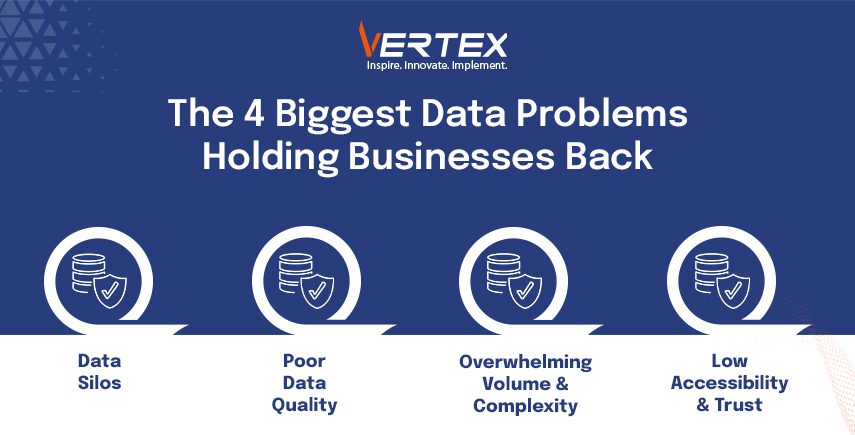
Companies using cloud computing and other cloud networks generate vast amounts of data regularly, yet when they have to use this data to make informed decisions, they struggle. This is because of the challenges that we have discussed below.
- Data Silos: Data silos are individual packets of data that are trapped in departmental or app specific systems. This data is often overlooked, and because of this, we can not create a unified view of business. According to a report done by Infoverity, As businesses introduce new technology to their systems, data silos are more likely to arise. More than 40% of surveyed organizations have struggled with this.
- Poor Data Quality: Having a lack of data is bad, but having a lot of data, but the quality and origin of that data is not trusted, then that is much worse. Furthermore, this flawed and incomplete data can lead to poor decisions that can cost companies millions. According to a report by Gartner, poor data quality costs organizations an average of $12.9 million per year.
- Data Complexity and Volume: Handling bulk amounts of data can be troublesome. The volume and variety of data that exists make the traditional approach useless. Data professionals spend most of their time combing through terabytes of data. According to Projectpro, data professionals spend 60% of their time organizing and cleaning data. Also, 57% of the individuals also dubbed it the most boring task of all.
- Lack of Accessibility and Trust: Companies have data, but they are unable to make use of it to their benefit. This leads to companies depending more on their gut than on data-driven insights.
- The challenges that we discussed above are the reason why companies are understanding the need for a unified data fabric. This understanding has made companies adopt data fabric for their operations, resulting in the overall growth of the data fabric market. According to Fortune Business Insights, the global data fabric market size was valued at USD 2.29 billion in 2023. The market is projected to be worth USD 2.77 billion in 2024 and reach USD 12.91 billion by 2032, exhibiting a CAGR of 21.2% during the forecast period.
Core Components and Principles of a Unified Data Fabric
Building a data fabric is not easy, since it is built using several foundational components that work together.
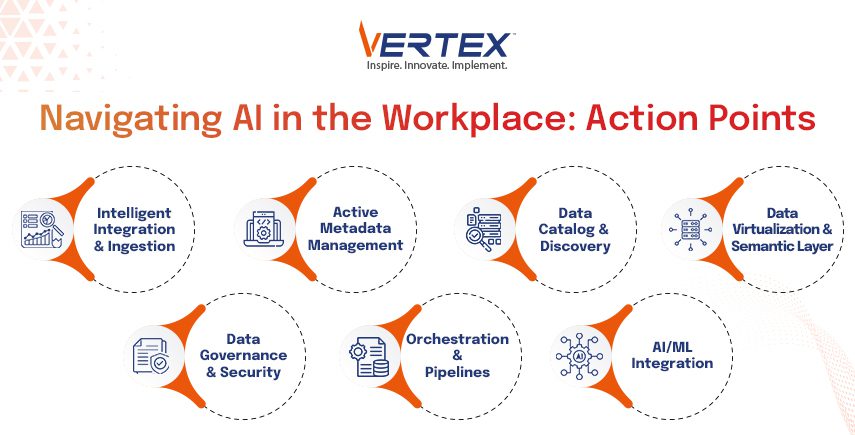
- Intelligent Data Integration and Ingestion: The fabric must be built to manage data from multiple sources, whether batch, streaming, or API-driven. To do this, there should be proper use of connectors, ELT/ETL tools, and real-time data streaming capabilities.
- Active Metadata Management: This is the “brain” of the data fabric. Active metadata goes beyond static descriptions, constantly analyzing data usage, lineage, relationships, and performance to recommend optimal data pipelines, transformations, and access patterns. According to a report by Gartner, by 2024, data fabric deployments would quadruple efficiency in data utilization while cutting human-driven data management tasks in half.
- Data Catalog and Discovery: Having a data repository is useless if we can not search and use the right dataset, so a searchable inventory is a must. This searchable inventory will help us to find, understand, and access relevant data assets, and with AI, it can be automated as well.
- Data Virtualization and Semantic Layer: This provides a viewing dashboard that can help display all the business-friendly data that can be used further. This step is achieved by removing all the underlying complexities and irrelevant data. Once this is done, there is a single unified data resource that can be revisited whenever necessary.
- Data Governance and Security: When working with this much data, government compliances become mandatory, and with bodies like GDPR and CCPA, data compliance across all policies is needed. According to Gartner, companies that successfully implement robust data governance policies alongside their integration efforts report 68% higher data quality scores
- Data Orchestration and Pipelines: The fabric helps in the automation and optimization of data flows, transformation, and preparation. This means that we have to also automate data management tasks, so that it reduces the time data scientists spend on it.
- Automation and AI/ML: Data fabric gets a serious boost when paired with machine learning algorithms. This results in better data discovery and quality checks and better optimization and predictive insights.
Benefits for Strategic Business Decisions
There are many advantages of implementing a unified data fabric and some of those benefits we have discussed below.
- Accelerated Time-to-Insight: Since there are no more silos of data, the time taken in accessing and analysing the data is reduced significantly. This allows the business to be quicker in terms of market change.
- Enhanced Data Quality and Trust: When a business constantly revisits its data quality rules and complies with every government rule, the quality of the data automatically improves. Furthermore, the reliability of data is increased.
- Improved Data Accessibility and Democratization: There is also the benefit of improved user accessibility, business users, analysts, and data scientist have their own view of the curated data. This helps them in making their own decisions, which will benefit the organization.
- Reduced Operational Costs: When there are no duplications in data, it significantly reduces manual effort and optimizes storage and costs, which helps the business thrive.
- Superior Strategic Decision-Making: With a centralized, real-time insight into unified data, a business can make more accurate forecasts and predictions. They are also able to identify underlying patterns and emerging trends more easily.
Challenges and Implementation Strategies
There are certain challenges that every business will face while building and implementing a unified data fabric. We have discussed some of them below.
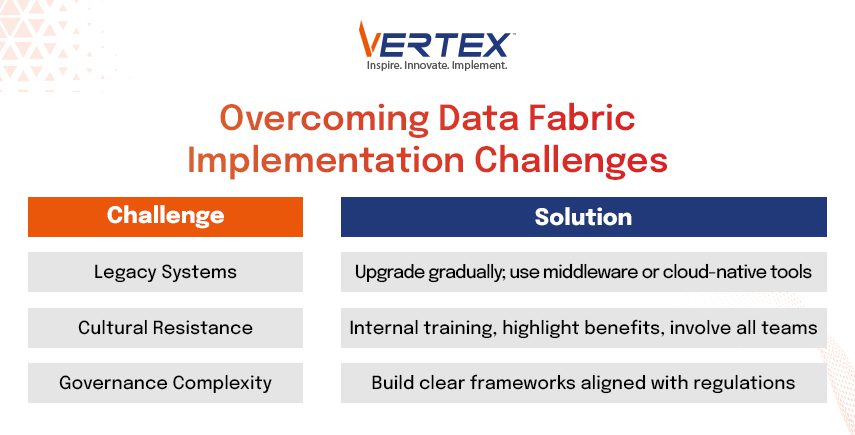
- Legacy Systems and Technical Debt: Integrating data fabric in systems that are outdated can be complex and, for sure, hinder the process.
- Organizational and Cultural Resistance: The shift from the traditional method to a more collaborative one is another challenge faced by many businesses; this can be avoided with proper training of departments.
- Data Governance Complexity: Establishing and then adhering to all the government policies is another challenge, and with such vast amounts of data, navigating through each compliance requires focus.
- Skill Gaps: There are pre-existing skill gaps in people working in the departments who are not trained to handle such a data interface, and cit an be a rigorous process.
Strategy for a Successful Implementation
- Instead of going all out first, isolate the critical business problems that can be resolved with a unified data fabric. Once you get tangible results, then you can switch to a bigger model.
- Start with a specific data set, and once you are able to achieve the desired result, you can expand the fabric to accommodate different data sources.
- Carefully research all the available fabric platforms and tools that will best suit your needs, and then factor in the cost you are willing to spend. Including platforms that operate using AI/ML is a major plus.
- A strong data governance framework goes a long way in helping the organisation establish a unified data fabric.
The Future is Fabric-Driven
With businesses approaching and embracing cloud computing more and more, real-time analytics and data-driven insights are crucial to come to the top. Having a unified data fabric can easily solve this problem, as we discussed in this article how a unified data fabric can cut down process timings, operational cost, and increase data-driven insights, profit, and reliability. So if you are a budding organisation confused about how to establish its own data fabric, do not fret, connect with us at VertexCS and we will take care of everything.
Recent Blogs

9 July, 2026

9 July, 2026

8 June, 2026

8 June, 2026

1 May, 2026

30 April, 2026
10 April, 2026

3 April, 2026
Recent News

26 February, 2026

6 December, 2025

1 August, 2025

2 February, 2025

14 November, 2024

4 November, 2024
1 August, 2024

6 March, 2024