
How Vertex Powers AI with a Modern Data Foundation
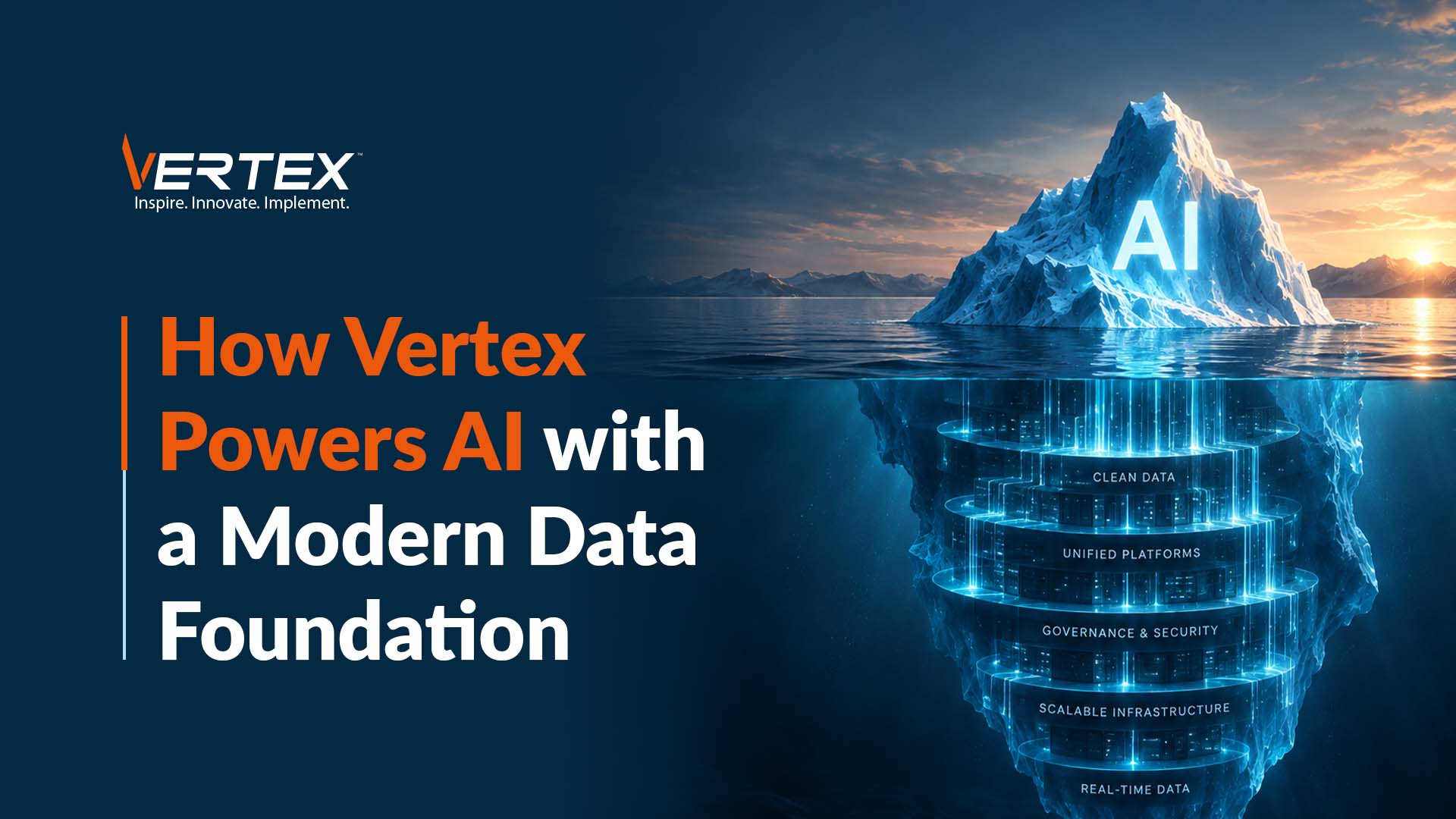
- Data first: Most AI initiatives fail because of the data, not the AI, since AI is only as intelligent as the data it learns from.
- Data quality: According to Gartner, poor data quality costs organizations an average of $12.9 million every year, and AI cannot clean messy enterprise data on its own.
- Data silos: AI needs complete business context from CRM, ERP, HR, marketing and customer support systems to generate meaningful insights.
- Governance: A modern data foundation includes governance policies, security controls, metadata management and role-based access, not just centralized storage.
- Scale: Pilots often rely on manually prepared datasets, so scaling AI requires standardized data models, governance frameworks, integrated systems and automated pipelines.
Artificial Intelligence has quickly moved from boardroom buzzword to business priority.
Organizations across industries are investing in AI to improve customer experiences, automate operations, optimize supply chains, detect fraud and accelerate decision-making.
From generative AI assistants to predictive analytics, the possibilities seem endless.
But the uncomfortable truth still persists.
Most AI initiatives don’t fail because of the AI.
They fail because of the data.
Companies are eager to implement AI, yet many overlook the one thing AI depends on the most, a strong, modern data foundation.
According to Accenture, 74% of organizations struggle to achieve and scale value from their AI investments, despite increasing spending on AI initiatives.
The reason behind this is simple.
AI is only as intelligent as the data it learns from.
Before asking “Which AI model should we use?”, organizations should first ask “Is our data ready?”
Let’s look at why a modern data foundation is the key to successful AI adoption and Vertex’s role in helping you reach there faster.
AI cannot Fix Poor Data
One of the biggest misconceptions about AI is that it can somehow clean, organize and correct messy enterprise data automatically.
Unfortunately, it can’t.
If your customer records are duplicated, sales data is inconsistent, inventory information is outdated, or financial systems don’t reconcile, AI will simply produce inaccurate insights.
If you are in analytics since long, you would have heard the phrase ‘Garbage in. Garbage out.’
Now with AI, the consequences have increased further.
According to Gartner, organizations estimate that poor data quality costs them an average of $12.9 million every year.
Imagine asking an AI model to forecast demand using incomplete inventory data or predict customer churn using inconsistent CRM records.
The recommendations may look convincing, but they won’t be reliable.
Before organizations can trust AI, they must first trust their data.
Data Silos Prevent AI from Seeing the Bigger Picture
AI performs best when it has access to complete business context.
Unfortunately, most organizations store data across disconnected systems:
- CRM platforms
- ERP applications
- HR systems
- Manufacturing software
- Marketing tools
- Customer support platforms
Each system contains valuable information, but AI cannot generate meaningful insights if it only sees part of the picture.
For example, if an AI model is trying to predict customer churn with only sales data, it will miss important signals that influence customer behaviour.
It needs complete information not only about sales but also data on customer support history, product usage and more.
AI needs Governance, not just Data
As AI becomes more deeply embedded in business operations, organizations must answer critical questions like where did this data come from, can we trust it, who has access to sensitive information and even questions on compliance and regulatory requirements.
Without proper governance, AI can introduce serious business risks.
According to IBM’s Cost of a Data Breach Report 2024, the global average cost of a data breach reached $4.88 million, the highest ever recorded.
A modern data foundation includes governance policies, security controls, metadata management, and role-based access not just centralized storage.
AI is only as Fast as your Data Infrastructure
Many organizations attempt to deploy AI on top of legacy infrastructure that was never designed for modern analytics.
Under these conditions, AI fails to operate efficiently.
Some pre-requisites for modern AI are cloud-based data platforms, Automated data pipelines, real-time data integration and Scalable storage among other things.
Without these capabilities, AI projects quickly become slow, expensive and difficult to scale.
Hence, organizations investing in platforms like Microsoft Fabric, Azure Data Lake, Databricks and modern data warehouses are better positioned to realize AI value.
AI Delivers Insights. Data Foundations Deliver Scale.
Many organizations successfully launch AI pilots.
Very few successfully scale them.
Have you wondered why?
Because pilots often rely on manually prepared datasets.
Scaling AI across the enterprise requires standardized data models, governance frameworks, integrated systems and automated pipelines.
According to McKinsey, while 78% of organizations now use AI in at least one business function, many still struggle to move from isolated use cases to enterprise-wide value because scaling AI requires significant organizational and data maturity.
The companies seeing the greatest return from AI aren’t necessarily using the most advanced models.
They are the ones that invested in the right data foundation first.
So the bottom line is, before looking for intelligence, organizations need to build strong data foundations and that’s where partners like Vertex can help you.
Vertex helps Organizations Build AI-Ready Data Foundations
At Vertex Computer Systems, we help organizations prepare for AI by first strengthening the foundation that makes it possible, their data.
With over 15 years of experience in data engineering, analytics, cloud modernization, and enterprise integration, Vertex helps businesses design scalable, AI-ready data ecosystems that unify information across disparate systems while ensuring data quality, governance, and security.
Our expertise spans modern data platforms, Microsoft Fabric, Azure, Power BI, data lakes, ETL pipelines, and enterprise analytics, enabling organizations to move from fragmented data environments to a single, trusted source of truth.
Rather than treating AI as a standalone implementation, Vertex helps clients build the modern data architecture needed to support predictive analytics, generative AI, intelligent automation and future innovation.
So the result are never limited to only successful AI pilots.
They become permanent solutions that can scale confidently across the enterprise.
Ready to make your business AI-ready?
Connect with Vertex to build a modern data foundation that transforms AI from an experiment into a measurable business advantage.
Recent Blogs
3 August, 2026
27 July, 2026
20 July, 2026
13 July, 2026
6 July, 2026
29 June, 2026

22 June, 2026
15 June, 2026
Recent News

26 February, 2026

6 December, 2025

1 August, 2025

2 February, 2025

14 November, 2024

4 November, 2024

1 August, 2024

6 March, 2024