

4 Reasons why Insurance Companies are Struggling with Underwriting and Claims Efficiency even with so much Data
- The problem isn’t data volume: insurance companies have more data than ever, yet underwriting and claims stay slow because that data is fragmented, not operationalized.
- Data silos block the full picture: underwriters and claims adjusters lose time toggling between disconnected systems, with 54% of underwriters saying admin work wastes their day.
- Legacy systems stall decisions: 74% of insurers still run outdated core platforms, so AI and predictive tools sit outside the workflows that need them.
- Data quality and governance erode trust: duplicated, inconsistent records make risk models unreliable, and talent plus process gaps slow every transformation.
- Vertex turns data into efficiency: we unify data ecosystems, modernize legacy systems, and embed analytics into underwriting and claims for faster, accurate decisions.
Insurance companies today have more data than ever before.
From telematics and wearable devices to credit scores, satellite imagery, IoT sensors, and decades of historical policy records.
The industry is literally swimming in information.
Yet, underwriting delays continue.
Claims cycles remain long.
Loss ratios fluctuate.
Customer dissatisfaction continues to rise.
However, the bigger question is, if data is abundant, why is efficiency still elusive?
The answer lies not in the quantity of data, but in how it is structured, integrated, governed, and operationalized.
Too many insurers still rely on disconnected systems and legacy processes that slow down underwriting instead of enabling it.
Here are four key reasons insurers continue to struggle and what forward-looking organizations are doing differently.
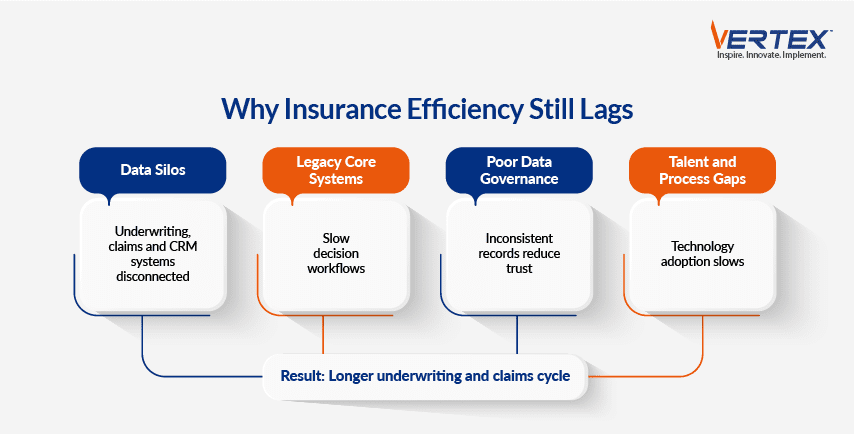
Data Silos are Blocking the Full Picture
Most insurance companies operate with legacy core systems layered with newer digital tools.
Over time, organizations keep on adding underwriting systems, claims platforms, CRM tools, fraud detection engines, and third-party data providers to the mix, but rarely unify.
The result?
Fragmented data ecosystems.
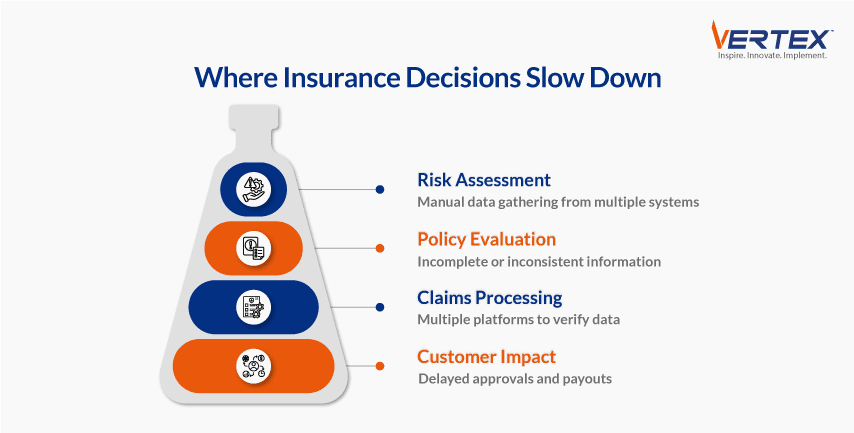
An underwriter may need to manually pull data from multiple systems to assess risk.
A claims adjuster has to toggle between platforms to verify policy history, past claims, and fraud indicators.
This slows decision-making and increases the risk of errors.
54% of underwriters say they waste too much time on admin and inefficient processes.
For example, consider an auto insurance claim involving telematics data.
If driving behaviour data is stored separately from policy records and accident history, the adjuster cannot instantly assess context.
That delay translates into longer claims cycles and frustrated customers.
At Vertex, we have helped insurers reduce underwriting turnaround times dramatically by implementing integrated data architectures that create a single source of truth.
When systems talk to each other in real time, decisions become faster and more accurate.
Legacy Systems Slow Down Decision Making
Many insurers still rely on decades-old policy administration systems.
These platforms were not designed for today’s data velocity or advanced analytics requirements. 74% of insurance companies still use outdated, legacy technology for pricing, rating, underwriting, and other vital insurance processes.
While insurers continue to invest in AI models or predictive tools, their capabilities often sit outside core systems.
This creates operational friction due to which insights are generated but never embedded into workflows.
Modernization is not just about upgrading technology.
It is about redesigning processes so analytics are embedded into everyday operations.
Data Quality and Governance Gaps Undermine Trust
More data does not automatically mean better decisions.
In fact, inconsistent, incomplete, or poorly governed data can create more problems than it solves.
Underwriters depend on accurate historical data to price risk appropriately.
Claims teams rely on reliable information to detect fraud and assess payouts.
If data is duplicated, outdated, or inconsistent across systems, decision confidence drops.
Let’s look at an example.
If a customer’s address appears differently across underwriting, billing, and claims systems, risk models may produce different results.
Multiply that issue across millions of policies, and inefficiencies multiply.
Without strong data governance frameworks, insurers struggle to maintain data integrity at scale.
At Vertex, our data and analytics practice focuses not just on analytics implementation but on building strong data governance foundations.
Talent and Process Gaps Slow Transformation
Insurance is a highly regulated, risk-sensitive industry.
While innovation is rapid, internal processes often remain conservative.
Many underwriting and claims teams still rely on manual reviews because processes were built around human judgment rather than automation.
Even when predictive models are available, employees may hesitate to fully trust algorithmic outputs without clear explainability.
There is also a growing talent gap.
Advanced analytics requires data scientists, data engineers, and domain experts who understand both insurance and technology.
Without the right talent and change management strategies, digital initiatives stall.
For instance, deploying an AI-driven fraud detection model is one thing.
Embedding it into daily claims workflows with dashboards, alerts, and training is another.
Vertex works closely with insurers to bridge this gap by combining technology expertise with deep industry understanding.
Our long track record of delivering enterprise-grade solutions ensures that modernization initiatives translate into measurable business outcomes.
Turning Data into True Operational Advantage
The insurers that will lead the next decade are not those with the most data but those who can turn data into intelligent, embedded decision-making.
At Vertex, we partner with insurance organizations to modernize their technology landscape, unify their data ecosystems, and embed advanced analytics directly into operational workflows.
Our expertise, long-standing client relationships, and proven delivery models help insurers move from fragmented systems to streamlined, high-performance operations.
If your underwriting or claims processes feel slower than they should, it may be time to rethink your foundation.
Connect with our experts today to explore how we can help you transform data into speed, accuracy, and measurable efficiency.
Recent Blogs

9 July, 2026

9 July, 2026

8 June, 2026

8 June, 2026

1 May, 2026

30 April, 2026

10 April, 2026

3 April, 2026
Recent News

26 February, 2026

6 December, 2025

1 August, 2025

2 February, 2025

14 November, 2024

4 November, 2024
1 August, 2024

6 March, 2024