

Leveraging AI and Machine Learning for Operational Efficiency and Innovation
- AI and ML as operational levers: They turn existing data into predictive maintenance, leaner supply chains, and automation that cut cost and downtime.
- Where the gains show up: Manufacturing uptime, inventory and logistics, RPA, customer-service bots, and HR screening are the highest-return areas.
- Innovation, not just savings: The same models surface new products, services, and decisions that were invisible in raw data.
- What blocks adoption: Poor data quality, an AI talent shortage, legacy-system integration, ethics and compliance, and employee resistance are the recurring hurdles.
- Where Vertex helps: We move enterprise AI/ML from pilot to production with the data foundation and governance that make it stick.
The business landscape is getting more and more competitive by the second, and coming out as an industry leader is becoming more and more tough. Organisations are struggling with increased costs, irregularities in operations, and an innovation block. In this dire time, Artificial Language and Machine learning have emerged as the tools that can save the day and provide the required solution. AI and ML both can help you generate insights that are data-driven, with predictive capabilities, and you can save a lot of money as well. Before scaling any of this, though, it helps to recognise the common data strategy red flags that stall these initiatives early.
Understanding AI and ML in the Context of Operations
AI or ML can be an extension of ourselves out there doing most of the heavy-duty work, if trained with the right datasets. AI can be programmed to carry out tasks via machines and automated assemblies; meanwhile, machine learning can be used to learn about patterns and trends, and insights from all the data collected can then be used for our benefit. AI and Machine Learning can be used for the automation of routine tasks, tasks that do not require human attention. After this is done, you can allocate the freed-up resource to a team where they can contribute more. One of the best benefits of AI and ML is that they can give your customers a customized experience.
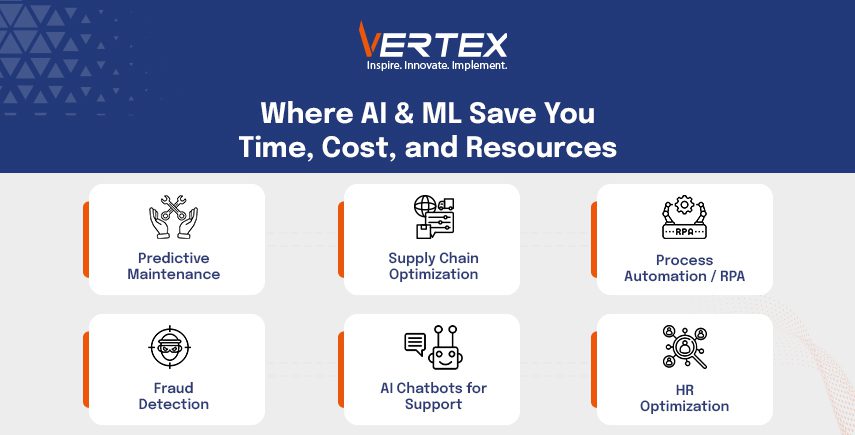
Key Areas Where AI/ML Drive Operational Efficiency
- Predictive Maintenance in Manufacturing and Infrastructure
Predictive maintenance is done by the data from the assembly line, both old and new data are processed to predict the future outcome, and prevent any future breakdown. This saves a lot of time, cost, and asset life, and the maintenance issue is resolved.
- Supply Chain Optimization
Machine learning can also help in predicting trends, patterns, and inventory. They analyze the already existing data as well as the real-time variables such as weather, traffic, inflation, and more. You can also use them to isolate inefficiencies and bottlenecks in the organisation. Amazon is a well-known example of this; they use AI to optimize their warehouses, routes for delivery, and even logistics.
- Process Automation and Robotic Process Automation (RPA)
AI automation is not limited to operating machinery or data processing; it can structure data, understand natural language, and make decisions without human intervention. These characteristics make it a super useful tool to master. A lot of organisations use AI as their POC and customer grievance officer.
- Fraud Detection and Risk Management
AI is best when it comes to detecting any anomalies in the system, and organisations use this to detect fraud, non-compliance, and unauthorised access. Whereas, ML algorithms are continuously evolving due to the increase in the number of frauds and the latest methods of online theft.
- Customer Support and Service Operations
Using AI chatbots in place of human employees is the new trend and rightly so, where a human employee can handle one query at a time, AI can target multiple queries and solve them. Big organisations like Zomato and Swiggy are using their own chatbots as the first point of contact for any grievances.
- Human Resource Optimization
AI also works as an HR associate, it scans resumes to find the most relevant one, analyzes performances, and workforce planning. This enables the HR to make more decisions and utilise the time in projects that require more attention. Across all these use cases, successfully integrating AI into the workplace depends as much on your people as on the technology.
Driving Innovation Through AI/ML
AI and ML are not only good for handling businesses, they are also great at enabling new business models and products. We have discussed them below as well.
- Product Development and Personalization
Machine learning models can be programmed to analyze customer behavior patterns, expenditure curves, and feedback so that you can curate an experience that is best for your customer. AI-driven customizations can guarantee a good customer service experience.
- Dynamic Pricing Models
You can also use ML to determine the pricing of your services, basing it on the demand for the product, cross-referencing it with your competitors’, factoring in inventory, and then setting the final price. Both Uber and Rapido use dynamic pricing for their service based on several factors.
- Intelligent Decision Support Systems
AI-enabled dashboards help leaders make decisions and also look after the performance of all employees. They can check their inventory, and from the insights they gain, they can gain knowledge about the organisation.
- Innovation in Healthcare and Life Sciences
AI is also used extensively in healthcare and drug discovery; it can generate a patient report based on old medical records and suggest treatment plans. This helps reduce a lot of the cost of research and development.
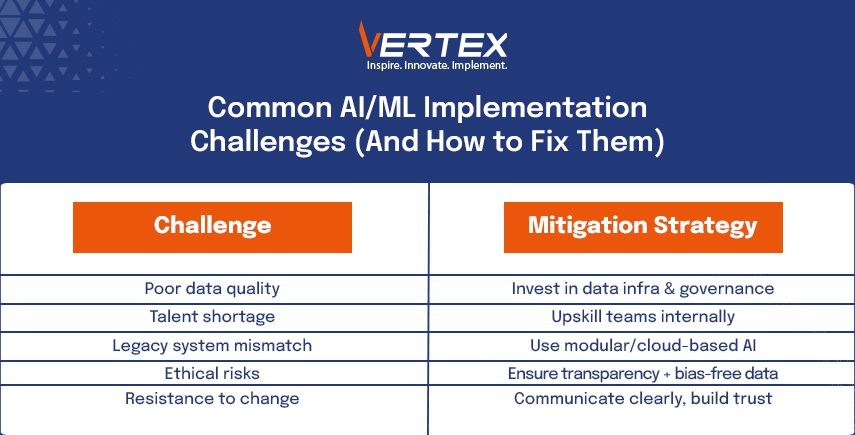
Implementation Challenges and Mitigation Strategies
Now that you understand the benefits, you must also learn about the challenges that most organisations face during the implementation of AI/ML.
- Data Quality and Availability
The efficiency of any AI or ML model depends on the datasets they are trained on, so if the data is of poor quality and fragmented, then the results will be the same. You will not be able to rely on the suggestions given by the AI models; furthermore, there will be no real-time data insights. To prevent this, you must invest in a data infrastructure and make sure there is data governance and compliance. This is also where building a data fabric to unify fragmented sources pays off.
- Talent Shortage
This is the most commonly shared challenge among different organisations; there are not many skilled AI professionals who can work on AI and ML models. This can only be solved by upskilling the entire department, teams, and superiors. Once they are trained and familiar with the models, they will be able to leverage the full power of AI.
- Integration with Legacy Systems
You can not use the latest AI models with outdated systems used in organisations, as the system will not be able to handle the processing power of AI and will eventually malfunction. This can be avoided by adapting modular AI solutions or cloud computing solutions. However, adopting these solutions will cost the organisation a significant amount.
- Ethical and Compliance Concerns
There are departments, sectors, and verticals where all the decisions need to be transparent and fair. There should be no bias in them, like healthcare, defense, HR. Now, in these sectors, if AI is used in decision-making, then we need to ensure that there are no biases in the data used to train the AI. This falls under our ethical responsibility, and it ties directly to the broader ethics of data analytics.
- Change Management and Resistance
AI is already a topic of discussion amongst most employees as they fear that with automation and AI, they will lose their jobs. Now this fear is real, and in order for them to move past it, they need to understand that AI is a tool that is for their own benefit. This can only be achieved with clear communication and trust-building exercises.
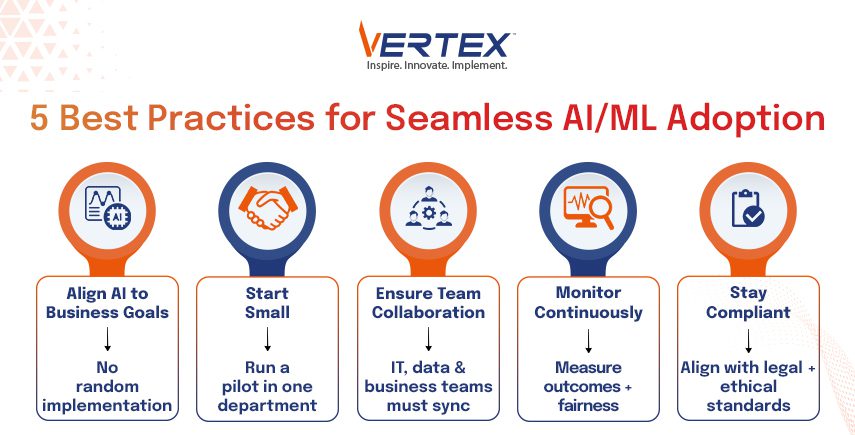
Best Practices for AI/ML Adoption
- Do not implement AI just for the sake of keeping up with trends; first, align your projects and needs, and understand the implementation process by a professional. Furthermore, if there is no need and you implement AI, you might lose money instead of saving it.
- Go with a segmented approach, never implement AI or ML across the entire organisation, and experiment first with a single department. If the results of the ROI are according to your expectations, then only expand the implementation.
- Make sure the involved departments like data scientists, IT teams ,and domain experts, are in sync and communicating clearly, otherwise it will be chaotic.
- Do not sit idly after implementation; monitor every single change, performance, fairness, security, and make sure everything is going well.
- Make sure that your AI models or ML models are up-to-date with government compliance.
Conclusion
AI and ML are crucial if you want your business to be a big hit. They are not capable of driving several aspects of business and improving them with data-driven insights. Predictive analysis plays a big role here in identifying trends, customer behavior patterns, and inventory as well. In this article we have discussed the benefits along with the challenges that you will face during the implementation of AI and ML models, so to save you the extra work, explore how Vertex’s data and AI services can help put these ideas to work, or contact our expert team at VertexCS and see how you can make your business better.
Recent Blogs
3 August, 2026
27 July, 2026

20 July, 2026
13 July, 2026
6 July, 2026

29 June, 2026

22 June, 2026

15 June, 2026
Recent News

26 February, 2026

6 December, 2025

1 August, 2025

2 February, 2025

14 November, 2024

4 November, 2024

1 August, 2024

6 March, 2024