

Is your Data Strategy DOA? 5 Red Flags that IT Leaders totally ignore
- Most Data Strategies Stall: Up to 80% of AI and analytics projects fail to deliver business value, usually because strategy and execution are misaligned.
- No ROI Means No Funding: When data initiatives aren’t tied to revenue, cost, or risk outcomes, executive confidence and budgets quietly fade.
- One Truth, Trusted Data: Conflicting definitions and poor data quality, costing $12.9M a year on average, erode trust and stall adoption. Establish a single source of truth.
- Dashboards Aren’t Decisions: Logging into a BI tool isn’t action. Analytics must be embedded into workflows to shape what happens next.
- Make It Business-Owned: Data strategy succeeds when business leaders co-own it with governance and cross-functional accountability. Vertex helps revive stalled strategies into outcome-driven ones.
Every organization talks about data as its most valuable asset.
But too few turn that promise into real, measurable outcomes.
The result?
Data strategies become Dead on Arrival (DOA).
Celebrated only in PowerPoints but invisible in day-to-day decisions.
Before you invest more in analytics tools or AI platforms, take a hard look at whether your data strategy is truly alive or quietly dying.
Here are some of these issues that IT leaders often overlook, which end up holding the organization back.
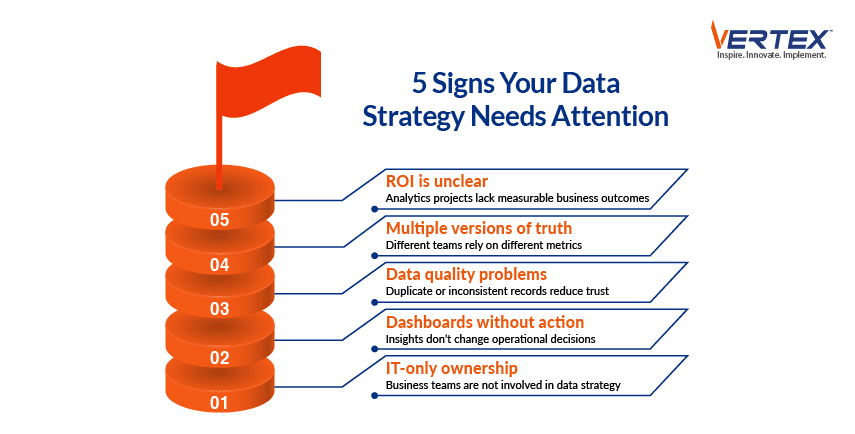
You can’t clearly Articulate ROI
A data strategy without measurable impact is just a technology investment.
Organizations often focus on implementation milestones:
- Data lake completed
- BI tool deployed
- AI model developed
But the real metrics should be business-focused:
- Revenue growth
- Cost reduction
- Risk mitigation
- Productivity gains
If teams cannot clearly connect data initiatives to financial or operational improvements, executive confidence fades.
Over time, funding becomes harder to justify.
Research from the Cambridge Centre for Business Analytics shows that up to 80% of AI and analytics projects fail to deliver intended business value, often due to poor alignment between strategy and execution.
Multiple Versions of the Truth Exist
When different departments rely on different definitions, KPIs, or datasets, decision-making slows dramatically.
Leadership meetings turn into reconciliation exercises instead of strategic discussions, and teams hesitate to act because they aren’t confident in the numbers.
According to IBM, 43% of chief operations officers identify data quality and consistency as major organizational challenges, with over a quarter estimating losses exceeding $5 million annually due to poor data.
Data Quality Issues are Normalized
Duplicate entries, inconsistent formatting, outdated master records, and incomplete fields are often treated as operational inconveniences rather than strategic risks.
But the financial impact is significant.
Gartner estimates that poor data quality costs organizations an average of $12.9 million per year.
Beyond cost, poor data quality undermines adoption.
When users repeatedly encounter inaccuracies, they stop trusting dashboards and revert to manual workarounds.
Once trust is lost, scaling analytics becomes nearly impossible.
Dashboards Exist, but Decisions don’t Change
Many organizations measure data success by dashboard adoption rates.
But logging into a BI tool is not the same as driving action.
If insights do not influence workflows like triggering operational adjustments, reprioritizing resources, or automating interventions, then they remain observational.
Analytics must be embedded into business processes.
Otherwise, they simply report what has already happened instead of shaping what happens next.
Data Strategy is IT-Led, not Business-Owned
When data initiatives are perceived as IT projects, they struggle to drive enterprise impact.
Successful strategies are often co-owned by business leaders.
They influence performance targets, compensation metrics, and operational planning.
Without cross-functional accountability, adoption plateaus.
Recent industry surveys show that 60% of data leaders now prioritize governance and cross-functional alignment as critical to long-term success, signalling widespread recognition that technology alone is insufficient.
So want to Revive your Stalled Data Strategy?
If these red flags feel familiar, intervention is possible.
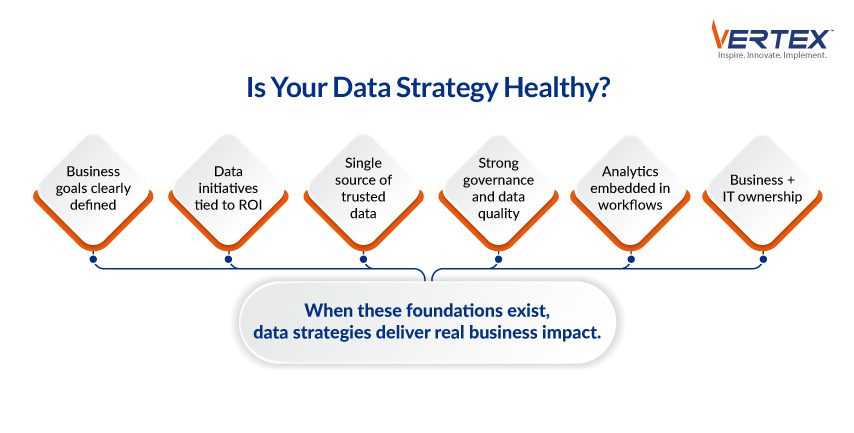
A healthy data strategy:
- Begins with clearly defined business objectives
- Establishes a single, trusted source of truth
- Prioritizes data quality and governance
- Embeds analytics into operational workflows
- Aligns cross-functional accountability
- Measures and communicates ROI consistently
At Vertex, we partner with enterprises to move beyond fragmented data initiatives toward fully integrated, outcome-driven strategies.
Our expertise in modernization, integration, governance, and analytics operationalization helps organizations convert data investments into measurable business performance.
Connect with us to transform your data strategy from infrastructure-focused to outcome-driven.
Recent Blogs

3 August, 2026

27 July, 2026

20 July, 2026

13 July, 2026

6 July, 2026

29 June, 2026

22 June, 2026

15 June, 2026
Recent News

26 February, 2026

6 December, 2025

1 August, 2025

2 February, 2025

14 November, 2024

4 November, 2024

1 August, 2024

6 March, 2024