

Are you an Automotive Plant with Advanced Analytics but still missing targets? Here’s why
- The problem isn’t missing data: automotive plants full of advanced analytics still miss targets because of what happens after the data is generated, not a lack of dashboards.
- Analytics without alignment: insights sit in separate MES, ERP, quality, and maintenance systems, so action does not follow fast enough and downtime creeps in.
- Dashboards rarely change behaviour: visibility alone does not lift performance until analytics move from reporting to operational execution, triggering work orders and alerts.
- Legacy systems and poor data quality: 15 to 20-year-old core systems block real-time action, and master data inconsistencies erode operator trust in the models.
- Vertex closes the gap: we modernize core systems, standardize data governance, and embed analytics into shop-floor workflows so insight becomes measurable action.
If you get an opportunity to walk into any modern automotive plant today, you will see dashboards everywhere.
Real-time OEE tracking, predictive maintenance models, AI-powered quality inspection, supply chain visibility platforms, and more.
On paper, it looks like a data powerhouse.
Yet many plants are still missing production targets, struggling with quality metrics, facing unplanned downtime, or watching margins shrink.
If advanced analytics is in place, why aren’t the numbers improving?
The issue isn’t a lack of data.
It’s what happens or doesn’t happen after the data is generated.
Let’s understand the reason behind this.
You only have Analytics, no Alignment
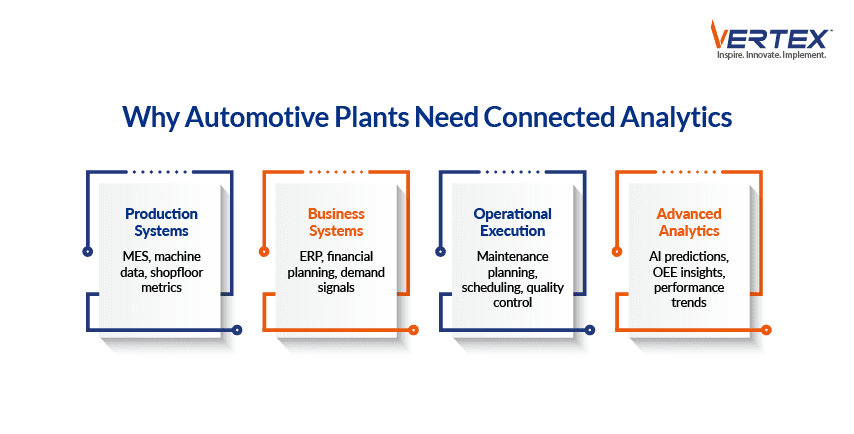
Most automotive plants have invested in multiple digital systems over time.
Production data sits in MES platforms.
Financial metrics are in ERP systems.
Quality analytics may live in a separate tool.
Maintenance has its own dashboards.
Each system works well independently.
But targets are missed because no one sees the full picture.
Let’s take an example.
Your predictive maintenance system flags a motor that is likely to fail in 7 days.
However, maintenance scheduling is handled in a separate system, spare parts availability is tracked elsewhere, and production planning doesn’t automatically adjust output.
The insight exists, but action doesn’t follow quickly enough, leading to downtime.
This happened not because of a lack of data but because there is no sync between them.
Dashboards Rarely Change Behaviour
But visibility alone doesn’t improve performance.
Let’s say your OEE dashboard shows that Line 3 is consistently underperforming by 4%.
Supervisors see it daily.
But unless root-cause analytics are embedded directly into workflow triggering maintenance checks, recalibrations, or supplier quality reviews, the same issue repeats.
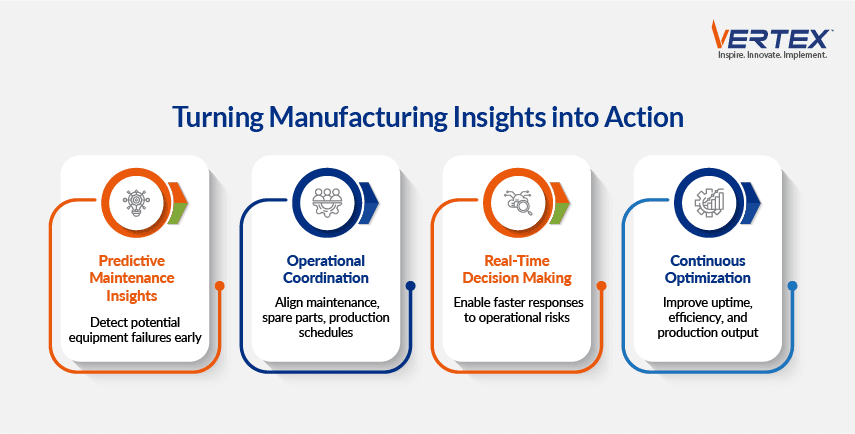
Hence, it is important that analytics move from ‘reporting’ to ‘operational execution.’
Usually, the plants that hit targets are the ones where insights automatically generate work orders, adjust production schedules, or escalate alerts to decision-makers, not just display numbers on a screen.
Legacy Systems are Slowing Down Real-Time Action
Automotive plants often operate on systems that were implemented 15–20 years ago.
While newer analytics layers may sit on top, the core production systems weren’t designed for real-time optimization, which leads to friction.
Automotive plants may have AI models predicting part defects based on temperature and pressure patterns.
But if the core quality management system requires manual validation before action is taken, response time lag is bound to stay high.
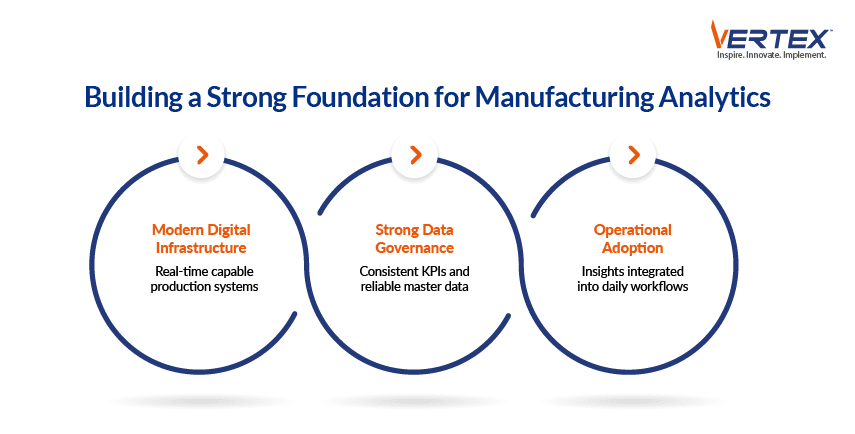
To make the most of new models, modern infrastructure is a must.
At Vertex, we have helped automotive manufacturers modernize their core systems in phased, low-risk ways, ensuring plants can embed AI and advanced analytics directly into production workflows without disrupting operations.
Data Quality is Undermining Trust
Operators don’t always trust analytics.
If different systems show slightly different numbers for the same KPI, confusion grows.
If a model flags a machine as ‘high risk’ but previous alerts turned out to be false positives, teams start ignoring it.
In one automotive plant we worked with, multiple part codes existed for the same component across procurement and quality systems.
The analytics model was technically correct, but the underlying master data inconsistencies caused misinterpretation.
After data governance was standardized, defect prediction accuracy improved significantly.
Without strong governance and a single source of truth, even the most advanced AI won’t deliver consistent results.
Targets are operational, but Analytics is Treated as IT
This may be the most critical reason of all.
In many organizations, analytics initiatives are driven by IT or innovation teams, while production, quality, and maintenance teams are measured on output and cost targets.
If the people responsible for hitting targets aren’t fully involved in designing analytics solutions, adoption suffers.
When analytics becomes part of daily shift reviews, performance conversations, and incentive structures, that’s when results shift.
At Vertex, we combine technology expertise with deep industry understanding to ensure analytics is not a side project.
It becomes embedded into operational culture.
Our long track record working with manufacturing enterprises allows us to bridge the gap between data science and shop-floor reality.
If your plant has advanced analytics but still struggles to meet throughput, quality, or cost goals, it may be time to rethink how your data is being used.
Recent Blogs

3 August, 2026

27 July, 2026

20 July, 2026
13 July, 2026

6 July, 2026

29 June, 2026

22 June, 2026
15 June, 2026
Recent News

26 February, 2026

6 December, 2025

1 August, 2025

2 February, 2025

14 November, 2024

4 November, 2024

1 August, 2024

6 March, 2024